

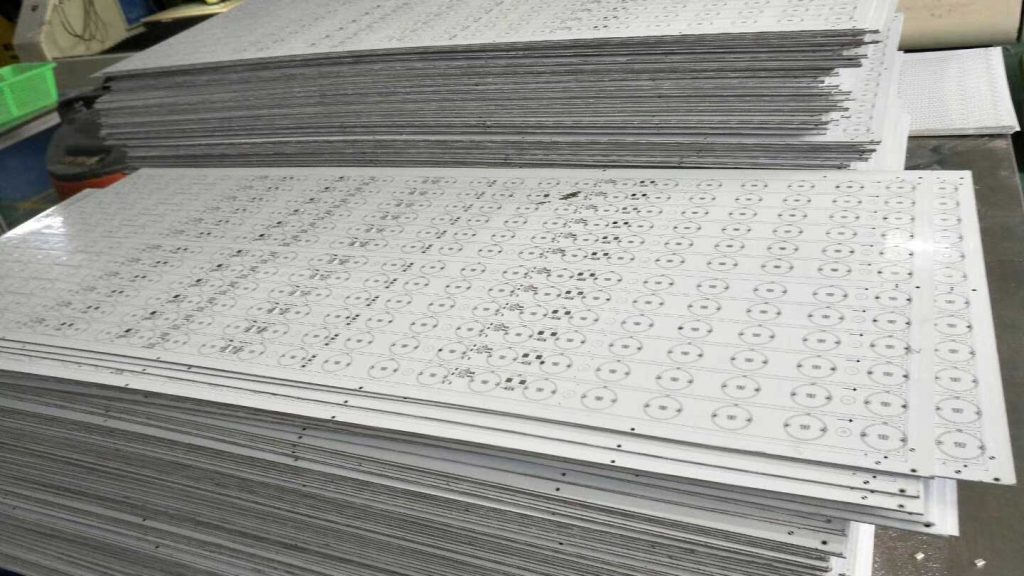
An aluminum substrate is a copper-clad aluminum substrate that offers excellent thermal conductivity, electrical insulation, and machinability. Metal-core PCBs, fully known as metal-core printed circuit boards, consist of a metal layer, a bonding layer (insulating layer), and a conductive trace layer—all three components are essential. The metal layer is not merely a layer of metal; it plays a crucial role in heat dissipation, shielding, and electrical connectivity.
Currently, many double-sided and multilayer boards have very high interconnect densities; combined with high-power surface-mount components, this makes it difficult to dissipate heat. Traditional printed circuit board substrates, such as FR4 and CEM3 (with thermal conductivities of approximately 0.35 W/m·K), are not suitable for efficient heat conduction, leading to localized overheating and high-temperature failure of electronic components. However, aluminum substrates easily solve this problem.
The manufacturing process for single-sided aluminum substrates is relatively simple; Jingpeng Electronics’ main orders for aluminum substrates consist primarily of double-sided and multilayer aluminum substrates.
Structure and Heat Dissipation Principles of Double-Sided, Multilayer Metal Substrates
Metal substrates primarily dissipate heat through two mechanisms: thermal conduction and thermal radiation, whereas traditional FR4 substrates can only dissipate heat through thermal radiation. When electronic components (such as LEDs) operate and generate heat, the heat is first transferred through the copper foil on the circuit layer to the thermal interface material, and then through the insulating medium to the metal block. Finally, the metal block conducts the heat to the outside, completing the heat dissipation process. Therefore, the insulating medium plays a crucial bridging role in the heat dissipation of metal substrates.
The thermal conductivities of various materials are as follows:
- Aluminum substrate: approximately 200 W/m·K.
- Copper foil: approximately 400 W/m·K.
- Standard FR4 insulating material: approximately 0.35 W/m·K.
- High-thermal-conductivity insulating media: 1.5 W/m·K, 2.0 W/m·K, 3.0 W/m·K.
These data clearly demonstrate that metal substrates offer significant advantages in heat dissipation. As a result, they are widely used in various fields, including lighting, healthcare, consumer electronics, power supplies, telecommunications, and aerospace.
Advantages of Double-Sided, Multi-Layer Metal Substrates
- Does not affect normal PCB routing: Metal substrates generally do not affect the normal routing requirements of a PCB; this is especially true for metal-core boards, which are essentially equivalent to adding a metal layer inside the PCB and have a minimal impact on the design of the various circuit layers.
- Even Heat Dissipation: A metal substrate enables uniform heat dissipation. Through the metal layer, heat generated locally on the PCB is rapidly conducted throughout the entire PCB, which then dissipates the heat, effectively preventing high-power components on the PCB from overheating and experiencing a decline in performance.
- Direct-Contact Cooling: In certain metal-core board designs, the inner metal layer is left exposed. Through direct contact between the metal layer and the outer metal shell, heat generated on the PCB is conducted to the outside, resulting in improved heat dissipation.
- Increasing PCB Rigidity: A metal substrate can also increase the overall rigidity of the PCB, thereby improving its durability.
Aluminum substrates, as an efficient heat dissipation solution, have become the preferred choice for many electronic engineers. Not only do they enhance the performance of electronic devices, but they also extend their service life.
Frequently Asked Questions
1. What is a metal substrate?
A metal substrate is a copper-clad aluminum substrate used in the manufacture of electronic devices, featuring excellent thermal conductivity.
2. In which fields are aluminum substrates widely used?
Aluminum substrates are widely used in a variety of fields, including lighting, medical equipment, consumer electronics, power supplies, telecommunications, and aerospace, and they perform particularly well in high-power electronic devices.
3. How do aluminum substrates differ from standard FR4 substrates?
Aluminum substrates have a higher thermal conductivity and can dissipate heat more effectively, whereas standard FR4 substrates have limited heat dissipation capabilities.
4. How do you choose the right metal substrate?
When selecting a metal substrate, it is necessary to consider its thermal conductivity, hierarchical structure, and the requirements of the specific application.
5. Does an aluminum substrate affect the layout design of a PCB?
Generally speaking, aluminum substrates do not have a significant impact on PCB layout design; this is especially true for metal-core boards, which cause very little interference with circuit design.
