

PCBA Testing Translating Functional Requirements into Verifiable Results
Based on circuit connections, functional performance, and project reliability requirements, clearly define the test items, operating conditions, and acceptance criteria. Shenzhen Jingpeng Electronics reviews test plans suitable for the project, taking into account design documents, test points, and delivery requirements.
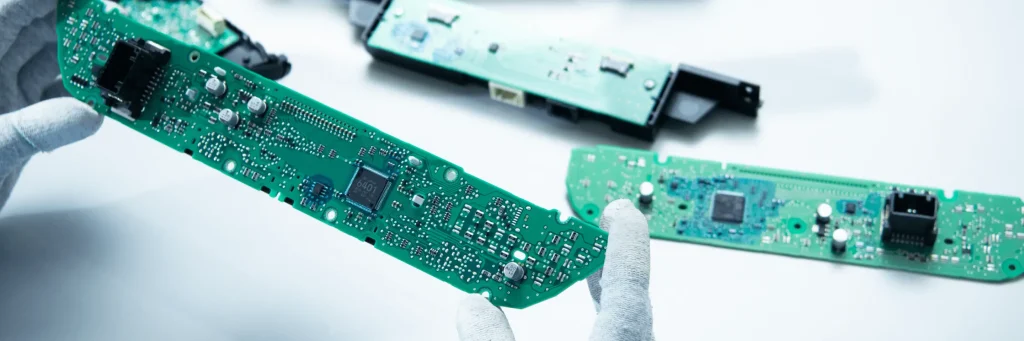
Manufacturing and Testing Collaboration | Specific configurations, coverage, and delivery records are confirmed on a project-by-project basis.
Different tests address different questions
ICT, FCT, and reliability-related tests each serve different purposes and should be scheduled in combination based on design testability and product requirements. The following outlines the review criteria; specific implementation conditions must be confirmed prior to production.
ICT · Online Circuit Testing
Focus on the circuit connections and accessible nodes after assembly; this can be used to check for open circuits and short circuits, as well as to verify the electrical parameters of certain components.
Prerequisites: Schematic, netlist, test points, fixture contact conditions, and parameter limits.
FCT · Functional Testing
Operate the PCBA under specified power supply, input, and load conditions to verify the agreed-upon interfaces, outputs, and functional flows.
Prerequisites: functional specifications, software versions, communication protocols, loads or peripheral devices, and compliance standards.
Aging and Repeated Operation
Operate the system under the specified time, load, and environmental conditions, and record any anomalies; for repeated actions or cyclic tests, clearly specify the number of cycles and the failure criteria.
Prerequisites: duration, operating mode, temperature, monitoring parameters, and shutdown conditions.
Environmental and Reliability Testing
Verify performance within the agreed-upon scope for test samples, conditions, and test resources related to temperature, humidity, vibration, and other parameters.
Prerequisites: Applicable standards, sample size, test curves, and reporting requirements; specific confirmation of resources and scope for implementation.
Passing a test indicates that the sample meets the evaluation criteria for the tests performed and under the specified conditions; it does not mean that all defects have been identified or that the entire unit is reliable in all environments.
First, confirm the coverage, then determine the testing method.
Accessibility
Inspect test points, probe spaces, connectors, and board obstructions to determine which nodes can be measured directly.
Functions and Boundaries
List the features to be tested, input and output ranges, exceptional conditions, and items not currently covered.
Quantity and Tempo
Evaluate the investment in jigs and automation based on the quantity of prototypes or mass-produced parts, changeover frequency, and testing time.
From Test Requirements to Results Documentation
01 · Organize Test Specifications
Align project versions, test lists, upper and lower limits, and pass/fail rules to form executable requirements.
02 · Verify the Fixture and Program
Verify the interfaces, power protection, firmware, test programs, and reference samples, and complete the validation as agreed.
03 · Execution and Exception Handling
Record test results and isolate defective boards for analysis; confirm the retest items and release criteria for repaired boards in accordance with the procedure.
04 · Summary and Retrospective Analysis
Link part identifiers, program versions, results, and exception records as required by the project, and clearly define the documentation to be included with the shipment.
What materials are required to initiate a test review?
- Circuits and Assembly
- Schematic, BOM, assembly drawing, netlist, and test point locations; specify the PCB/PCBA version.
- Functional Specifications
- Power supply range, interface definitions, communication protocols, output specifications, and load conditions.
- Software and Fixtures
- Firmware, programming and configuration instructions, test programs, fixture documentation, and reference samples.
- Acceptance and Delivery
- Test items, limit values, requirements for sampling or 100% inspection, record formats, quantities, and target delivery dates.
Make test results easy to locate and review
Recording Subject
Record the panel identification, batch number, hardware, and software versions as agreed to prevent the mixing of results from different versions.
Record the results
Specify the project name, pass/fail thresholds, pass/fail status, and the measured values or logs that need to be retained.
Record Disposition
Distinguish between initial testing, root cause analysis, and retesting after corrections, and establish rules for retesting and final release.
Frequently Asked Questions About PCBA Testing
What is the difference between bare PCB testing and PCBA testing?
Electrical testing of bare boards primarily focuses on circuit connections; PCBA testing focuses on assembled circuits and may include connections, component parameters, functionality, and other agreed-upon items.
Are ICT and FCT interchangeable?
The two have different focuses. ICT focuses on measurable nodes and electrical structures, while FCT verifies functionality under specified operating conditions; the combination should be determined based on the design and coverage objectives and cannot simply be interchanged.
Can we start communicating even without a test program?
Please provide the schematic diagram, functional specifications, and interface specifications first. The review of test requirements, testability, and preparation of programs or fixtures will follow; the division of responsibilities, costs, and timeline will be confirmed separately.
Are all boards subjected to aging or environmental testing?
Not all tests are performed by default. The test subjects, sampling or 100% inspection methods, timing, and conditions must be determined in accordance with project agreements; some reliability tests also require a specialized resource review.
Does passing a test mean the product won't fail?
This inference cannot be drawn. The conclusion applies only to the items and conditions that have been tested; untested functions, long-term use, and the overall operating environment still require appropriate verification.
First, clarify the testing criteria, then schedule the delivery.
Submit the PCBA documentation, test specifications, and quantities to Shenzhen Jingpeng Electronics, and jointly confirm the scope of work, test preparations, and delivery records.
