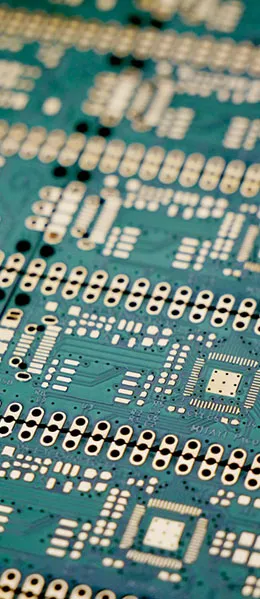
Currently, there are four types of next-generation PCB cleaning technologies:
Semi-Water Cleaning Technology
Semi-aqueous cleaning primarily uses organic solvents and deionized water, along with a certain amount of surfactants and additives. This cleaning method falls between solvent cleaning and water cleaning. These cleaning agents are organic and flammable solvents with high flash points and low toxicity, making them safe to use; however, they must be thoroughly rinsed off with water and then air-dried. Some cleaning agents contain 5%~20% of water and a small amount of surfactant, which not only reduces flammability but also facilitates rinsing.
Characteristics of the Semi-Water Washing Process
– It has strong cleaning power, capable of removing both polar and nonpolar contaminants simultaneously, and its cleaning effectiveness is long-lasting;
– Two different types of media are used for cleaning and rinsing; pure water is generally used for rinsing;
– Rinse and let dry.
Disadvantages of this technology
The treatment of waste liquids and wastewater is a relatively complex issue that requires a comprehensive solution.
Water-Based Cleaning Technology
Water purification technology represents the future direction of clean technology, and it is essential to establish facilities for treating both pure water sources and wastewater. This technology uses water as the cleaning medium, to which surfactants, additives, corrosion inhibitors, chelating agents, and other substances are added to form a series of water-based cleaning agents. These agents can remove water-soluble and nonpolar contaminants.
Features of the Cleaning Process
– Safe to use; non-flammable, non-explosive, and essentially non-toxic;
– The cleaning agent offers a high degree of formulation flexibility. It can easily remove both polar and nonpolar contaminants, providing a broad cleaning range;
– Multiple cleaning mechanisms. Water is a polar solvent with strong polarity. In addition to dissolution, it exerts a combination of effects, including saponification, displacement, and dispersion. The use of ultrasound is more effective than using organic solvents;
– As a natural solvent, it is relatively inexpensive and widely available.
Disadvantages of Water Cleaning
– In areas with scarce water resources, this cleaning method consumes a large amount of water and is limited by local natural conditions;
– Certain parts of the unit should not be washed with water, as the metal components are prone to rust;
– High surface tension makes it difficult to clean small crevices, and residual surfactants are hard to remove completely;
– Difficult to dry, high energy consumption;
– The equipment is expensive, requires a wastewater treatment system, and takes up a lot of space.
No-Clean Technology
Use clean-free flux or clean-free solder paste during the soldering process. No cleaning is required after soldering; the process can proceed directly to the next step. Clean-free technology is currently the most widely used alternative. In particular, mobile communication products almost exclusively use clean-free methods to replace ODS. Currently, a variety of no-clean fluxes have been developed both domestically and internationally, such as those from Beijing Jingying Company. Clean-free fluxes can be broadly categorized into three types:
– Rosin-based flux: Inert rosin-based solder (RMA) is used in reflow soldering and does not require cleaning.
– Water-soluble flux: Rinse with water after welding.
– Low-solid-content flux: No washing required.
No-clean technology offers advantages such as simplified process flows, reduced manufacturing costs, and lower pollution levels. Over the past decade, the widespread adoption of no-clean soldering technology, no-clean flux, and no-clean solder paste has been a major trend in the electronics industry since the late 20th century. The ultimate solution for phasing out CFCs is the implementation of no-clean technology.
Solvent Cleaning Technology
Solvent cleaning primarily relies on the solvent’s dissolving power to remove contaminants. Solvent cleaning is used because solvents evaporate quickly, have strong dissolving power, and require minimal equipment. Depending on the cleaning agent selected, they can be classified as flammable or non-flammable cleaning agents. The former primarily include organic hydrocarbons and alcohols (such as organic hydrocarbons, alcohols, and ethylene glycol esters), while the latter primarily include chlorinated hydrocarbons and fluorinated hydrocarbons (such as HCFCs and HFCs).
HCFC Cleaning Agents and Characteristics of Their Cleaning Processes
This is a hydrogen-containing HCFC. It has low latent heat of vaporization, good volatility, decomposes easily in the atmosphere, and has a minimal impact on the ozone layer. It is classified as a transitional substance and is scheduled to be phased out by 2040. Therefore, we do not recommend using this type of cleaning agent.
There are two main issues:
– First, it is transitional. Due to its ozone-depleting effects, its use is permitted only until 2040;
– Second, they are relatively expensive and have poor cleaning performance, which increases cleaning costs.
Characteristics of the Chlorinated Hydrocarbon Cleaning Process
Chlorinated hydrocarbons such as dichloromethane and trichloroethane are also non-ODS cleaning agents.
Features of the Cleaning Process
– Exceptionally effective at removing grease;
– Like ODS cleaning agents, it can also be steam-cleaned and steam-dried;
– The cleaning agent is non-flammable and non-explosive, making it safe to use;
– The cleaning agent can be distilled, recovered, and reused, making it cost-effective;
– Low toxicity and minimal environmental pollution;
– The cleaning process is the same as that for ODS cleaning agents.
However, one of its drawbacks is that chlorinated hydrocarbons are highly toxic, so special attention must be paid to workplace safety; second, chlorinated hydrocarbons are poorly compatible with common plastics and rubber; and third, chlorinated hydrocarbons are unstable, so stabilizers must be added when they are used.
Characteristics of Hydrocarbon Cleaning Processes
Hydrocarbons are simply hydrocarbons. In the past, gasoline and kerosene obtained by distilling crude oil were used as cleaning agents. The flash point of hydrocarbons increases as the number of carbon atoms increases, which improves safety but reduces drying efficiency; conversely, those with good drying properties are unsafe to use, creating a dilemma. Of course, when selecting a cleaning agent, one should prioritize those with good fire resistance and a high flash point. Characteristics of the cleaning process:
– Highly effective at removing oil stains, durable, low surface tension, and effective at cleaning crevices and pores;
– Does not corrode metals;
– Can be recovered through distillation, is reusable, and is relatively economical;
– Low toxicity and minimal environmental pollution;
– The same medium can be used for both cleaning and rinsing, making it convenient to use.
The main drawback of hydrocarbon cleaning processes is safety; they require strict safety measures.
Characteristics of the Alcohol Cleaning Process
Among alcohols, ethanol and isopropanol are commonly used as polar organic solvents in industry. Methanol is highly toxic and is generally used only as an additive. The characteristics of alcohol-based cleaning processes are as follows:
– It has good solubility for ionic contaminants, is effective at cleaning rosin-based flux, and has poor solubility for grease;
– Good compatibility with metal materials and plastics; does not corrode or expand;
– Dries quickly; can be air-dried easily without the need for hot air;
– It has good dehydrating properties and is commonly used as a desiccant.
The main issues with alcohol-based cleaning agents are their high volatility, low flash point, and flammability. Explosion-proof measures must be implemented for cleaning equipment and auxiliary equipment.