

Passive ComponentsThese are components in a circuit that do not generate energy, primarily including resistors, capacitors, and inductors. These components play a crucial role in the design and manufacture of electronic products.
However, as electronic products continue to become smaller, more multifunctional, and more powerful, the demands placed on PCBs (Printed Circuit Boards) are also increasing.
Consequently, the use of embedded passive components has gradually become a significant trend.
Why Choose Embedded Passive Components?
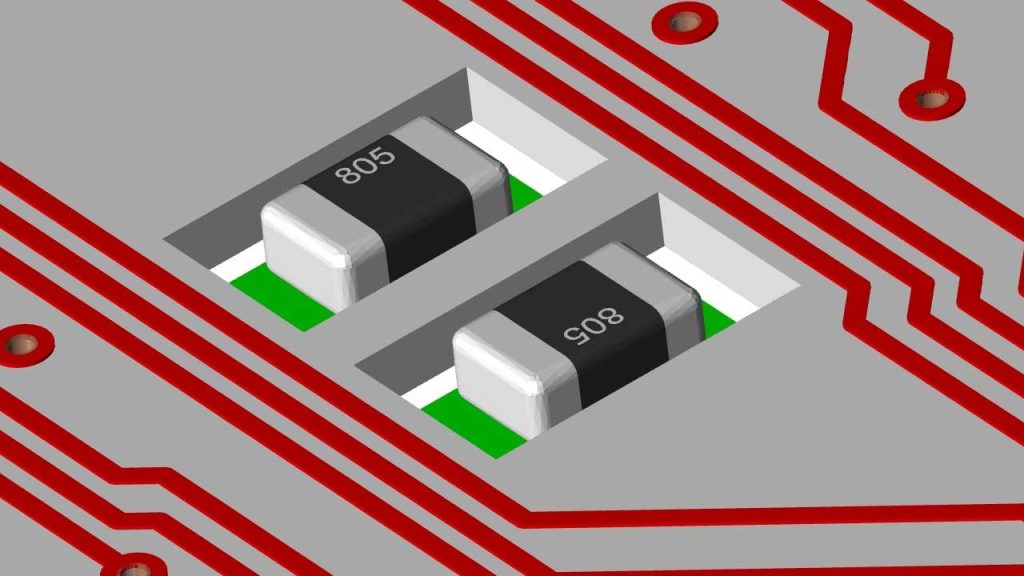
1. Increase PCB Density
Typically, discrete passive components require a significant amount of space, which results in larger PCBs.
However, in some applications, especiallyHigh-Density Interconnect (HDI)In stacked buried via (BUM) technology, space is at a premium.
By incorporating embedded passive components, the size of the PCB can be reduced by approximately 25%, which means fewer through-holes, shorter traces, and higher PCB density.
2. Improve the reliability of PCB assembly
Traditional discrete passive components are soldered onto the surface of the PCB, which can lead to solder joint failures.
Embedded passive components have fewer solder joints, resulting in higher assembly reliability.
In addition, embedded components are protected by the PCB, making them less susceptible to damage from moisture and harmful gases, thereby reducing the likelihood of damage to passive components.
3. Improve Electrical Performance
The electrical performance of electronic interconnects is significantly improved through the use of embedded passive components.
Because discrete passive components require additional connections, they can introduce parasitic effects, such as stray capacitance and parasitic inductance. These effects can negatively impact circuit performance.
Embedded components eliminate these effects and improve the electrical performance of the circuit.
4. Cost Savings
Products that incorporate embedded passive components typically have lower manufacturing costs.
Compared to other manufacturing methods, such as low-temperature co-fired ceramics (LTCC), embedded passive components can reduce component costs, substrate costs, and assembly costs.
Furthermore, they use traditional PCB manufacturing processes, which improve production efficiency.
However, it is worth noting that embedded passive components also have some limitations.
First, for passive components with high functional values, it is necessary to develop special embedded passive component materials.
Second, it can be somewhat challenging to control the functional errors of embedded passive components, particularly in planar embedded passive components.
Although there are some adjustment and control methods, not all embedded passive components can meet the design requirements.
Embedded passive components are a major trend in electronic product design because they enhance PCB density, reliability, and electrical performance while reducing costs.
However, when selecting and applying embedded passive components, manufacturers, designers, and engineers need to carefully consider materials, functional tolerances, and other factors.
Only in this way can embedded passive components fully realize their advantages.
FAQ
What are passive components?
Passive components are components in electronic circuits that do not generate energy; they include resistors, capacitors, and inductors.
Why Choose Embedded Passive Components?
Embedded passive components can improve PCB density, assembly reliability, and electrical performance while reducing costs.
What are the application areas for embedded passive components?
Embedded passive components are widely used in high-density interconnect (HDI) and buried via (BUM) technologies, such as in smartphones, communication devices, and computers.
How Can Functional Errors in Embedded Passive Components Be Controlled?
Controlling functional errors in embedded passive components typically requires laser trimming and other techniques, but these are not suitable for all components.
What are the challenges in manufacturing embedded passive components?
The manufacture of embedded passive components requires specialized materials and processes and may present challenges such as material selection, functional tolerances, and cost.
