

Printed circuit boards are a key component of modern electronic products, and the ALIVH (Any Layer Interstitial Via Hole) process, as an emerging technology, has opened up entirely new possibilities for the design and manufacture of multilayer boards. Below, let’s take a look at the key points of the ALIVH process for printed circuit boards.
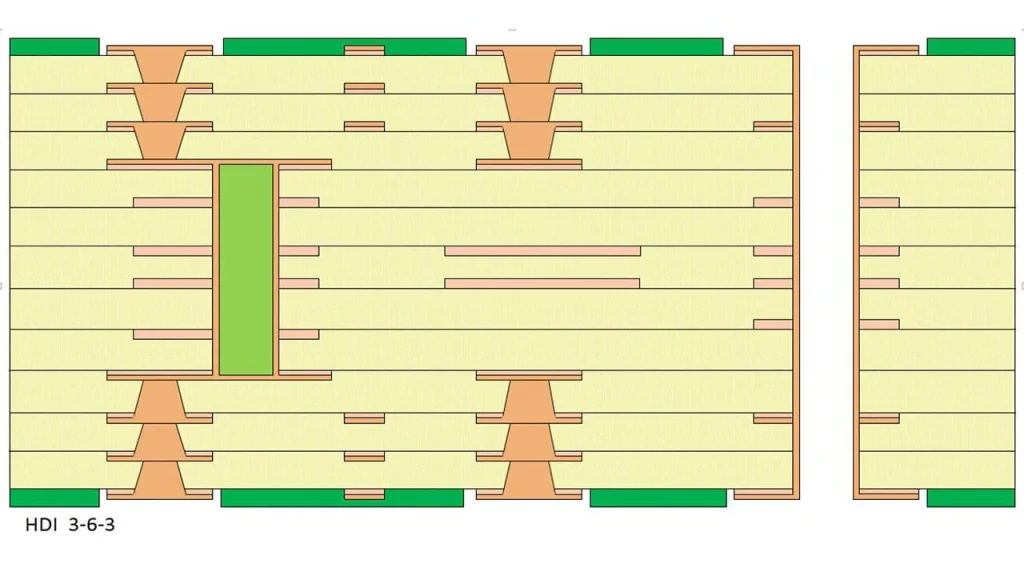
1. Selection of Insulating Materials
Selecting the appropriate insulating dielectric material is critical to the ALIVH process. The material must meet the requirements for high temperature (high TG) and low dielectric constant. Typically, aramid nonwoven fabric is used as a reinforced prepreg material, offering characteristics such as light weight, low dielectric constant, low coefficient of thermal expansion, and good surface smoothness. In particular, its negative coefficient of thermal expansion can be matched to the chip’s CTE, thereby enhancing the thermal stability of the substrate.
2. Selection of Conductive Adhesive
The conductive adhesive used in the ALIVH process should possess characteristics consistent with those of epoxy resin. Select a conductive adhesive with low shrinkage, i.e., one with low volatile content or a CTE that matches that of the core board (preferably less than 35 ppm). In addition, the conductive adhesive should exhibit high electrical and thermal conductivity, as well as good heat resistance and resistance to soldering thermal shock.
3. Dimensions and Shape of the Steel Mesh
The dimensions and shape of the steel mesh should be designed appropriately based on the diameter and shape of the through holes in the core board. This ensures that the conductive adhesive, once sealed in place, forms a raised semicircular shape, thereby improving the stability of the connection.
4. Optimization of Metal Particles in Conductive Adhesives
In conductive adhesives, the size, shape, and arrangement of metal particles must be optimized to ensure the formation of a low-viscosity conductive adhesive material for filling high-density through-holes. Through optimization, “zero” shrinkage of the conductive adhesive can be achieved, thereby improving the reliability of the connection.
5. Improved Surface Flatness
To ensure a stable connection, the surface must be made smoother. A high-quality grinding process should be used to grind down any protruding conductive adhesive, creating a smooth, blemish-free surface that is flush with the surrounding area.
As an innovative technology, the ALIVH process has brought about significant changes in the manufacturing and design of printed circuit boards. It enables higher line density, narrower line widths and spacing, and smaller via diameters. This process is particularly well-suited for high-speed circuits, providing strong support for the miniaturization and high performance of electronic products.
The ALIVH process is a significant innovation in the field of printed circuit board (PCB) manufacturing. By optimizing insulating materials, conductive adhesives, and manufacturing processes, it enables higher performance and reliability. PCB manufacturers, PCB designers, and PCBA manufacturers will provide a detailed explanation of the key points of the ALIVH process for PCBs, contributing to the advancement of electronic products.
