

Aluminum Substrate, as an important electronic material, plays a pivotal role in numerous applications. This article will delve into the composition, properties, applications, and processing requirements of aluminum substrates to highlight the significance and versatility of this material.
1. Composition of Aluminum Substrates
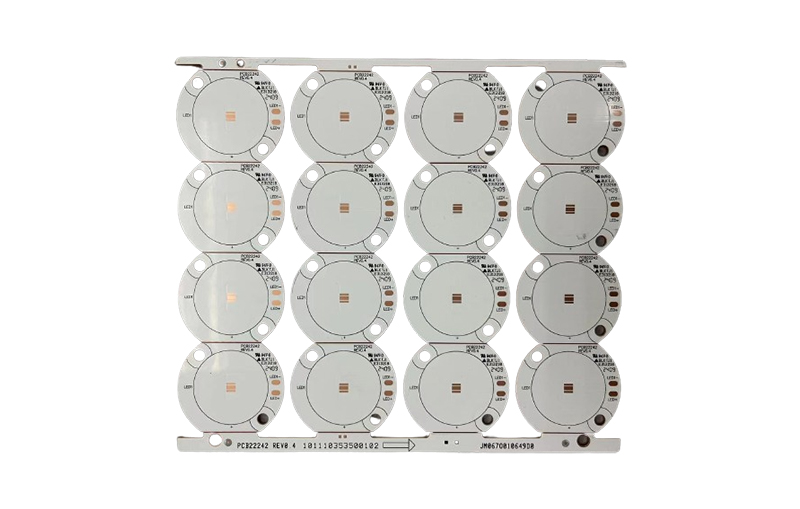
Aluminum substrates typically consist of three main layers: the circuit layer, the thermally conductive insulating layer, and the metal base layer.
1.1 Circuit Layer
The circuit layer is the core of an aluminum substrate and contains the circuits for electronic components. To ensure high current-carrying capacity, the circuit layer typically uses thicker copper foil, with a thickness generally ranging from 35 μm to 280 μm.
1.2 Thermal Insulation Layer
The thermally conductive insulating layer is one of the key technical features of aluminum substrates. Composed of a special polymer filled with specialty ceramics, it offers extremely low thermal resistance, excellent viscoelastic properties, and resistance to thermal aging. The primary function of this layer is to withstand mechanical and thermal stress while maintaining electrical insulation properties. High-performance aluminum substrates such as IMS-H01, IMS-H02, and LED-0601 incorporate this thermally conductive insulating layer technology, endowing them with exceptional thermal conductivity and electrical insulation properties.
1.3 Metal Substrates
The metal substrate serves as the supporting structure for the aluminum base plate and must possess high thermal conductivity. Typically, the metal substrate is an aluminum sheet, but a copper sheet may also be used, particularly when higher thermal conductivity is required. This layer is suitable for various conventional machining operations, such as drilling, punching, and cutting.
Advanced: Parameter Ranges for Each of the Three Layers
The original text divides the aluminum substrate into three parts: the circuit layer, the thermally conductive insulating layer, and the metal base layer. In engineering practice, each layer has a clearly defined range of values and specific design considerations:
| 层 | Common Sizes | Key Trade-offs |
|---|---|---|
| Circuit Layer (Copper Foil) | 35 μm–280 μm (approx. 1 oz–8 oz) | The thicker the conductor, the higher the current-carrying capacity; however, the current-carrying capacity decreases as the conductor becomes thinner. |
| Thermal Insulation Layer | Ceramic-filled polymer, 50–200 μm thick | The thinner it is, the lower the thermal resistance, but the voltage withstand capability decreases. |
| Metal Substrate | Aluminum sheet (5052 / 6061) or copper sheet, 1.0–3.0 mm | Aluminum is light and inexpensive; copper has higher thermal conductivity but is heavy and expensive. |
One of the things that’s most easily overlooked is:The insulation layer is the bottleneck in the entire thermal resistance chain.. Aluminum substrates have a very high thermal conductivity, while the insulating layer typically has a thermal conductivity of only 1–3 W/m·K; thinning this layer or replacing it with a material that has higher thermal conductivity often reduces the junction temperature more effectively than thickening the aluminum substrate.
- Dielectric strength and thermal resistance are a pair of conflicting properties: The thinner the insulation layer, the lower the thermal resistance; however, the voltage withstand capability decreases accordingly, so a balance must be struck between the two;
- Copper thickness and line width are a trade-off: The minimum line width that can be reliably achieved with a 280-micrometer copper thickness is significantly greater than that achievable with a 35-micrometer copper thickness;
- Choosing Between Copper-Based and Aluminum-Based Materials: Copper offers higher thermal conductivity, but its weight, cost, and difficulty of processing are all higher; it is worth considering only when thermal resistance constraints are extremely tight.
For a general classification and uses of metal substrates, seeAluminum SubstrateOne page.
2. Process Requirements
The manufacture of aluminum substrates involves a variety of process requirements, including gold plating, tin spraying, OSP oxidation resistance, electroless gold plating, and lead-free RoHS processes. The selection of these processes depends on the end product’s application and performance requirements.
Advanced: How to Select Surface Treatment Processes for Aluminum Substrates
The gold plating, tin plating, OSP, electroless gold plating, and lead-free processes mentioned in the original text involve slightly different trade-offs on aluminum substrates compared to conventional FR-4:
| Process | Features | Points to Note When Working with Aluminum Substrates |
|---|---|---|
| HASL Solder Plating | Low cost, good wettability | High-temperature processes place high demands on the heat resistance of insulation layers and sheet materials. |
| OSP | Smooth surface, low cost | Short shelf life; performance degrades after multiple refills |
| ENIG (Electrolytic Nickel-in-Gold) | Flat, suitable for fine-pitch applications | The costs are relatively high, and you should be aware of the risks associated with over-the-counter trading. |
| Hard Gold Plating | Wear-resistant | Mostly used for contact surfaces; high cost |
| Lead-Free ROHS Manufacturing Process | Compliance Requirements | Peak temperatures are higher; the heat resistance of the insulation must be verified. |
You can select the convergence option in three steps:
- First, let's look at the number of welds and the storage period.: For applications requiring multiple reflow cycles or batch welding over long periods, tin spraying offers the best tolerance;
- Next, let's look at the flatness requirements: For fine-pitch devices and high-density BGAs, choose immersion gold or OSP;
- Final Confirmation of Process Feasibility: Aluminum substrates conduct heat quickly; for certain processes requiring prolonged exposure to high temperatures, it is essential to confirm these requirements with the board manufacturer in advance.
For a comparison of surface treatment systems, seeHow to Choose a PCB Surface Treatment Process与4 Common PCB Surface Treatments。
3. Product Features
Aluminum substrates have several outstanding properties, including:
- Thin insulation layer, low thermal resistance: The thermal insulation layer is designed to have extremely low thermal resistance, which helps ensure efficient heat dissipation.
- Non-magnetic: Aluminum substrates are non-magnetic and are suitable for applications that are sensitive to magnetic fields.
- Good heat dissipation: Aluminum substrates offer excellent thermal conductivity and are particularly well-suited for applications requiring efficient heat dissipation.
- High mechanical strength: The metal substrate of aluminum-based panels offers high mechanical strength and excellent durability.
4. Areas of Application
Aluminum substrates are widely used in many fields, one of which is as a carrier for LED-specific hybrid power ICs (HICs). Because LEDs and related devices require efficient heat conduction and heat dissipation, aluminum substrates have become the ideal choice.
Advanced: In Which Scenarios Are Aluminum Substrates Suitable, and in Which Are They Not?
Applications suitable for aluminum substrates typically share the following common characteristics: “high heat flux density, limited space, and requirements for dielectric strength”:
- LED Lighting and Fixtures: The most common application is to use an aluminum substrate to lower the LED junction temperature and slow down light decay;
- Power Module: Applications with a high density of power devices, such as switch-mode regulators, DC/AC converters, and rectifier bridges;
- Automotive Electronics: Igniters, electronic regulators, and power controllers, which must be both heat-resistant and vibration-resistant;
- Power Hybrid IC (HIC) Packaging: The typical applications mentioned in the original text have specific requirements for both insulation and thermal conductivity;
- Communications and Audio Amplifiers: High-frequency amplifiers, like audio amplifiers, benefit from low-thermal-resistance paths.
Conversely, the following scenarios are not suitable for using aluminum substrates:
- RequiredMulti-Layer Through-Hole InterconnectsComplex circuits—the aluminum substrate acts as a conductor, and plating on the through-holes can cause a short circuit with the base layer;
- Low power and extremely cost-sensitiveFor this product—FR-4 with thermally conductive vias—is often more cost-effective;
- RequiredBending or Custom-Shaped LaminatingStructure—Consider using flexible slabs or a combination of rigid and flexible slabs.
For additional requirements in the automotive sector, please refer toAutomotive Circuit Boards vs. Conventional Circuit Boards。
5. Price and Performance Considerations
When selecting aluminum substrates, it is necessary to weigh the trade-off between thermal conductivity and cost. Some sheets with high thermal conductivity, such as those from Bergs in the U.S., are suitable for applications requiring highly concentrated heat transfer, but they are relatively expensive. Domestic materials, on the other hand, may be slightly inferior in terms of heat dissipation but are more cost-effective.
Advanced: Break Down the Selection Process into Five Actionable Steps
- Calculate the thermal budget: Determine the allowable total thermal resistance based on the device power and the target junction temperature;
- Fixed Insulation Layer: Determine the thermal conductivity and thickness based on thermal resistance and voltage withstand requirements;
- Determine the thickness of the copper: Based on the operating current and wiring precision, select a value between 35 and 280 μm;
- Establish a grassroots foundation: Whether to choose aluminum or copper, what thickness to use, and whether a thermoelectric separation structure is needed;
- Confirm Process and Cost: Please confirm the surface treatment, machining methods, and batch pricing together.
The balance between price and performance mentioned in the original text essentially comes down to Step 2: Imported sheets with high thermal conductivity offer better performance but are more expensive, while domestic materials are more economical but provide slightly inferior heat dissipation. The most practical approach is toSelect the appropriate setting based on the heat budget....rather than unconditionally pursuing the highest thermal conductivity.
For information about the panels themselves, seeWhat material is aluminum substrate sheet made of?; For a comparison of the overall material systems, seePCB Materials。
6. Frequently Asked Questions
1. What is DPPM?
DPPM (Defective Parts Per Million) is a metric for product defect rates, indicating the percentage of defective products per million. In the manufacture of aluminum substrates, DPPM is used to assess product quality levels.
2. In which fields are aluminum substrates used?
Aluminum substrates are widely used in LED lighting, power modules, automotive electronics, and telecommunications equipment, and are particularly suitable for applications requiring efficient heat dissipation and electrical insulation.
3. What makes the thermally conductive insulating layer on an aluminum substrate unique?
The thermally conductive insulating layer is composed of a polymer filled with special ceramics. It features low thermal resistance, excellent viscoelastic properties, and resistance to thermal aging, making it one of the key technologies for aluminum substrates.
4. How do you choose the right aluminum substrate?
When selecting aluminum substrates, factors such as the application, performance requirements, and budget should be taken into account. Different aluminum substrates are suitable for different applications, so the choice should be based on specific needs.
5. What is the difference between an aluminum substrate and a standard FR4 board?
Aluminum substrates offer superior heat dissipation and electrical insulation properties, making them suitable for applications with stringent requirements for heat dissipation and electrical performance, whereas standard FR4 boards perform less well in these areas.
6. Is a thinner insulation layer on an aluminum substrate better?
No. Thinner materials can reduce thermal resistance, but this comes at the expense of voltage withstand capability and long-term reliability. The correct approach is to first determine the voltage withstand rating required for the product, then reduce the thickness as much as possible while ensuring that the voltage withstand requirement is met, and select a dielectric with a higher thermal conductivity.
7. Can through-hole plating be performed on aluminum substrates?
Generally, this is not possible. Since the aluminum substrate is a conductor, plating through-holes would cause a short circuit with the substrate. Therefore, aluminum substrates are primarily single-sided; when double-sided interconnections are required, special insulation treatment must be applied or an alternative structure used, and feasibility must be confirmed with the board manufacturer in advance.
8. In what scenarios is a thermoelectric separation structure suitable?
This approach is suitable for applications requiring very high power density where the thermal resistance of standard aluminum substrates is insufficient. It involves bonding the device’s thermal pads directly to the bare aluminum substrate, eliminating the intermediate insulating layer, which significantly reduces thermal resistance. However, this comes at the cost of a more complex manufacturing process and the need to reevaluate the insulation design.
9. How do you test the dielectric strength of an aluminum substrate?
High-potential (Hi-Pot) tests are typically performed on finished products; the voltage and duration are determined based on the product’s safety standards, commonly in the range of 2–4 kV. The key objective of the test is to verify that the insulation has not been damaged during machining processes such as drilling or edge milling.
10. How can you verify the heat dissipation performance of an aluminum substrate?
The most reliable method is to conduct actual measurements: during the prototype stage, measure temperatures at multiple points using thermocouples, or directly measure the temperature of the device package and calculate the junction temperature based on the thermal resistance, then compare the results with the estimated values. Relying solely on material parameters does not account for the effects of actual factors such as solder voids and interface contact.
Conclusion
Aluminum substrates are a versatile electronic material with excellent thermal conductivity and electrical insulation properties. They are widely used in numerous fields and are particularly well-suited for the heat dissipation requirements of LEDs and high-power electronic devices. Selecting the appropriate aluminum substrate is crucial for product quality and requires a comprehensive consideration of factors such as performance, application areas, and cost. The future development of aluminum substrates will continue to be driven by advances in electronic technology, bringing more innovation and possibilities to industries across the board.
Further Reading:How to Choose the Right SMT Placement Machine · How to Choose a PCB Surface Treatment Process
