

Multilayer board lamination is a critical step in the printed circuit board (PCB) manufacturing process, directly determining the overall quality and performance of the PCB. A high-quality PCB ensures the stability, reliability, and superior performance of electronic devices, and one of the most crucial quality factors is the lamination quality of the multilayer board. Against the backdrop of the rapid development and increasingly widespread application of modern electronic products, improving the lamination quality of multilayer boards has become a critical task in the PCB manufacturing process. This article will focus on how to improve the lamination quality of multilayer boards through three key aspects, thereby ensuring the production of high-quality PCBs.
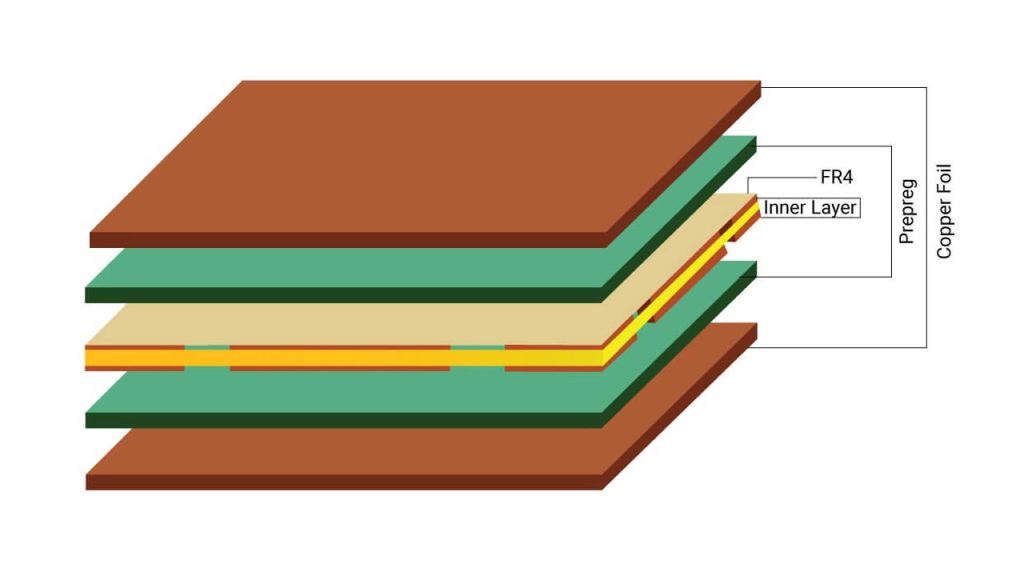
How Can the Laminating Quality of Multilayer Boards Be Improved?We recommend starting with the following three areas:
Selecting the Appropriate PP and CU Foil Configuration
Customer requirements for PP primarily relate to the thickness of the dielectric layer, dielectric constant, characteristic impedance, dielectric strength, and the smoothness of the laminated surface. Therefore, when selecting PP, the following factors should be considered:
- Resin can fill the gaps in the printed circuit traces during the lamination process.
- During lamination, air and volatile substances between the layers are thoroughly removed.
- It can provide the necessary dielectric layer thickness for multilayer boards.
- Ensure bond strength and surface finish.
- Copper foil is available in various models based primarily on PCB customers' requirements, and its quality complies with IPC standards.
Based on many years of production experience, I personally believe that PP can be configured with 7628, 7630, or 4-layer boards such as 7628+1080 and 7628+2116. 1080 or 2116 are the primary PP materials for multilayer boards with six or more layers, while 7628 is mainly used to increase the thickness of the intermediate layers. Additionally, the PP layers must be placed symmetrically to ensure a mirror-like finish and prevent warping.
The core board design meets lamination requirements
With the gradual advancement of laminating machine technology, hot presses have evolved from the non-vacuum models of the past to today’s vacuum hot presses. The hot-pressing process takes place within a sealed system, making it invisible and inaccessible. Therefore, it is necessary to properly design the inner laminate before lamination.
Here are some guidelines:
- The thickness of the core panels should be selected based on the total thickness requirements for the multilayer panel. The core panels should be of uniform thickness with minimal deviation, and the cutting directions (warp and weft) should be consistent. In particular, for multilayer panels with six or more layers, the warp and weft directions of each inner core panel must be consistent—that is, warp layers must overlap with warp layers, and weft layers with weft layers—to prevent unnecessary warping of the panel.
- There should be a certain distance between the outer dimensions of the core board and the active cells—that is, the distance from the active cells to the edge of the board should be as large as possible to avoid wasting material. Generally, the spacing for a four-layer board should be greater than 10 mm, and for a six-layer board, greater than 15 mm. The greater the number of layers, the larger the distance should be.
- Design of定位 holes: To minimize misalignment between layers in multilayer boards, the following should be noted when designing定位 holes: For 4-layer boards, only 3 or more定位 holes need to be designed for drilling. For multilayer boards with six or more layers, in addition to designing positioning holes for drilling, at least five layer-overlap positioning rivet holes and at least five positioning holes for the riveting tool plate should also be designed. However, the higher the number of layers for the positioning holes, rivet holes, and tool holes, the greater the number of holes should be, and their positions should be as close to the edge as possible. The primary purpose is to minimize alignment deviations between layers and allow for greater manufacturing tolerance. The target shape should be designed to meet the requirements for automatic recognition by the drilling machine as much as possible; it is generally designed as a complete circle or a set of concentric circles.
- The core board must be free of open circuits, short circuits, oxidation, and must have a clean surface with no residual film.
- Core Board Processing Techniques
When laminating multilayer boards, the core panels must be treated.
The treatment processes for inner layers include black oxidation and browning. The black oxidation process involves forming a black oxide film on the inner copper foil, with a thickness ranging from 0.25 to 4.50 milligrams per square centimeter. The browning process (horizontal browning) involves forming a thin organic film on the inner layer copper foil. The purpose of the inner layer laminate treatment process is:
- Increase the specific surface area of contact between the inner layer of copper foil and the resin, thereby enhancing the adhesion between the two.
- It enhances the effective wetting of the copper foil by the flowing molten resin, enabling the flowing resin to penetrate the oxide film sufficiently and exhibit strong adhesion after curing.
- Resistance to the Decomposition of Dicyandiamide, a Curing Agent in Liquid Resin, at High Temperatures—The Effect of Moisture on Copper Surfaces.
- Improve the acid resistance of multilayer boards during wet processes to prevent powder rings.
Control of Laminating Parameters
Controlling lamination parameters primarily involves the coordinated adjustment of “temperature, pressure, and time.”
Temperature and several temperature-related parameters are critical during the lamination process.
These include changes in the resin’s melting temperature, curing temperature, the heating plate’s set temperature, the material’s actual temperature, and the heating rate. The melting temperature refers to the point at which the resin begins to melt when the temperature rises to 70°C. As the temperature rises further, the resin melts more and begins to flow. Between 70 and 140°C, the resin flows easily. It is precisely because of this flowability that the resin can fill and wet the substrate. As the temperature gradually increases, the resin’s flowability first increases, then decreases. Finally, when the temperature reaches 160–170°C, the resin’s flowability drops to zero; this temperature is referred to as the curing temperature. To ensure better resin filling and wetting, it is crucial to control the heating rate. The heating rate reflects the lamination temperature, i.e., it controls both the heating time and the temperature increase. Controlling the heating rate is a critical parameter for laminate quality. The heating rate is generally maintained at 2–4°C/min. The heating rate is closely related to the type and amount of PP used. For 7628 PP, the heating rate can be slightly faster, i.e., 2–4°C/min; for 1080 and 2116 PP, the heating rate can be controlled at 1.5–2 °C/min. At the same time, when the PP content is high, the heating rate should not be too fast, because an excessively fast heating rate results in poor wetting of the PP, high resin flow, and insufficient time, which can easily cause the sheet to slip, thereby affecting the lamination quality. The temperature of the hot plate primarily depends on heat transfer between the steel plate, the steel plate itself, and the kraft paper; it is generally set at 180–200°C.
Pressure and multi-layer pressing pressure are based on the fundamental principle that the resin can fill the interlayer voids and expel interlayer gases and volatiles.
Since hot presses are classified into non-vacuum and vacuum types, there are different pressurization methods starting from the initial pressurization stage, including two-stage and multi-stage pressurization. Generally, non-vacuum presses use standard pressurization or two-stage pressurization. Vacuum systems typically employ two-stage or multi-stage pressurization. Multi-stage pressurization is generally used for high-precision, thin, multi-layer panels. The pressure is typically determined based on the pressure parameters provided by the PP supplier and generally ranges from 15 to 35 kg/cm².
Time and time-related parameters primarily refer to the control of lamination and pressing time, heating time, and curing time.
For two-stage and multi-stage lamination, the key to controlling lamination quality is to control the main pressure application time and determine the transition time from initial pressure to main pressure. Applying main pressure too early can lead to excessive resin extrusion and excessive resin flow, resulting in insufficient adhesive in the laminate, thin sheets, or even sliding sheets. If main pressure is applied too late, it can lead to defects such as weak bonding interfaces, voids, or bubbles.
Therefore, determining the software parameters for temperature, pressure, and time is a key technical aspect of multilayer board processing. Based on many years of practical experience in lamination, we believe that the software parameters—temperature, pressure, and time—can be effectively coordinated.
Only after a successful pressure test can the optimal software parameters for “temperature, pressure, and time” be determined. However, these “temperature, pressure, and time” parameters may vary depending on the specific PP laminate structure, PP supplier, PP grade, and PP properties. After lamination, the product must pass QC inspection to ensure it meets design requirements. In the production of printed circuit boards, as long as manufacturing strictly adheres to the above requirements and relevant process specifications, the lamination quality of multilayer boards can be effectively improved.
