

With the rapid development of electronic products and the advancement of smart technology, PCBs (Printed Circuit Boards) play a crucial role in the electronics industry. As one of the key stages in the PCB manufacturing process, the quality and efficiency of PCB microvia processing directly impact the overall performance and reliability of the product. This article will provide a detailed overview of the three most widely used PCB microvia drilling technologies—mechanical drilling, CO₂ laser drilling, and UV laser drilling—and delve into their characteristics, current status, and future trends.
What are micropores?
According to the latest definition in IPC-T-50M, a microvia is a blind or buried via with a diameter of ≤0.15 mm, a maximum aspect ratio of 1:1, and a maximum depth of no more than 0.25 mm from the starting layer to the ending layer.
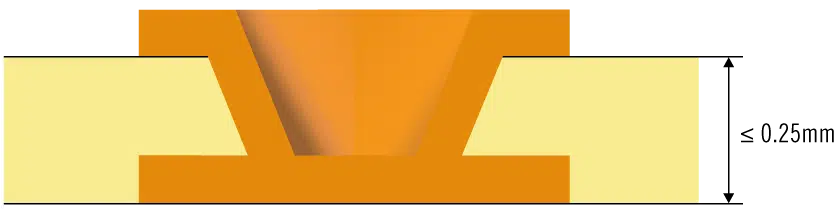
IPC-6012 also defines the structure of micropores:
- A micro-via is a blind via structure with a maximum aspect ratio of 1:1 and a total through-hole depth not exceeding 0.25 mm.
- Generally, NCAB recommends a dielectric thickness of 60–80 µm between the start and end layers of laser-drilled blind vias.
- The diameter of micro-via holes ranges from 80 to 100 micrometers, with a typical aspect ratio ranging from 0.6:1 to 1:1; the ideal aspect ratio is 0.8:1.
Mechanical Micro-Hole Drilling Technology
Mechanical drilling is the most widely used technology for micro-hole machining in PCBs. Its main features include high-speed machining (with a maximum rotational speed of 350,000 revolutions per minute) , hole profile (where wall roughness is typically controlled to ≤30 μm), hole diameter (where diameter tolerance is typically controlled to ≤+10 μm/-40 μm), and hole positioning (where positioning accuracy is typically controlled to within ≤±50 μm). Mechanical drilling uses drill bits, typically made of tungsten-cobalt alloy (hardmetal). Currently, the commonly used micro-hole drill diameters for PCBs are generally 0.1, 0.15, 0.2, and 0.25 mm (though 0.05 mm and 0.075 mm are also available, they are rarely used in actual mass production). When machining microvias, attention should be paid to parameters such as speed/cutting speed, feed rate/feed amount, return speed, number of laminates, and bit status.
Laser Micro-Hole Drilling Technology
The rise of laser drilling technology is primarily driven by the trend toward denser, thinner, and flatter PCBs, as mechanical drilling cannot achieve fast and stable mass production. The main characteristics of laser drilling are that it is an optical processing method with high quality requirements for hole shape (e.g., hole wall roughness is generally controlled to ≤18 μm), hole diameter (e.g., hole diameter tolerance is generally controlled to ≤±20 μm), and hole position (e.g., hole position accuracy is generally controlled to ≤±20 μm). Currently, the most commonly used laser drilling machines are CO₂ laser drilling machines and UV laser drilling machines. CO₂ laser drilling machines are mostly dual-axis, dual-table models that process two plates simultaneously using time-division or beam-splitting methods, thereby improving processing efficiency. The processing parameters for laser drilling include beam diameter, pulse width, number of pulses, as well as the beam movement speed and travel path for UV laser drilling machines.
Current Status and Future Trends in PCB Micro-Hole Processing Technology
Currently, mechanical drilling and laser drilling are the most widely used micro-hole processing technologies in the PCB industry. Mechanical drilling technology is mature and stable, and is suitable for most micro-hole processing needs. Laser drilling technology is suitable for applications with higher requirements for hole shape and positioning. As the electronics industry places increasing demands on PCB density and dimensions, micro-hole processing technology faces new challenges and opportunities. In the future, the trend in micro-hole drill bit development will be to reduce WC particle size from 0.3–0.2 μm to the nanoscale, change the structure from dual-flute to single-flute, and increase the drill point angle to improve torque and toughness. Laser drilling technology will also continue to innovate, improving machining precision and stability to meet the ever-growing demand for PCB microvia processing.
PCB microvia processing technology plays a crucial role in the modern electronics industry. Mechanical drilling and laser drilling, as the two most widely used microvia processing technologies today, each have their own unique characteristics and areas of application.
As the electronics industry continues to evolve, the demand for micro-hole machining technology is also on the rise. Ongoing innovation in micro-hole drill bits will drive the development of PCB micro-hole machining technology toward higher precision and greater efficiency. Continuous breakthroughs in laser drilling technology will provide higher-quality, more reliable solutions for PCB micro-hole machining.
In the future, PCB manufacturers, designers, and processors will continue to focus on and drive innovation in PCB microvia processing technology to meet the ever-increasing demand for electronic products.
