

PCB boards in electronic products are covered with all kinds of electronic components. How are they mounted so precisely on the PCB?
This is all thanks to SMT (Surface Mount Technology) and one of its key processes—solder paste printing.
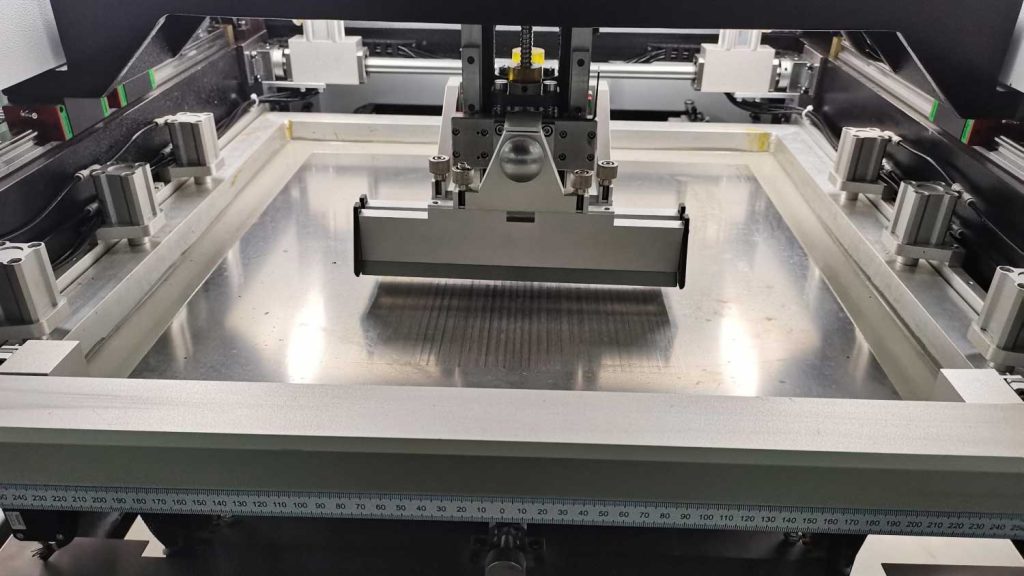
1. SMT Front-End Equipment: Solder Paste Printer
Among the front-end equipment on an SMT production line, solder paste printers play a critical role. The task of these printers is to precisely apply solder paste to the pads on a PCB to facilitate the proper placement and soldering of electronic components in subsequent stages.
2. The Solder Paste Printing Process
The SMT solder paste printer operates as follows: First, a steel plate is prepared; the grid pattern on this plate corresponds one-to-one with the pad locations on the PCB. Next, the steel plate is mounted onto the solder paste printer, ensuring that the grid pattern aligns perfectly with the PCB pads.
Once positioning is complete, the squeegee on the solder paste printer moves back and forth across the stencil, forcing the solder paste through the mesh of the steel plate to precisely coat the PCB pads, thereby completing the solder paste printing process.
3. Classification of SMT Solder Paste Printers
3.1 Fully Automatic Solder Paste Printer
This type of printer is typically used in high-volume SMT production lines. Once the relevant parameters are set, the machine automatically performs the printing and conveying processes, moving the PCB to the next workstation.
3.2 Semi-Automatic Solder Paste Printer
Semi-automatic solder paste printers are typically used during the pilot production phase or in diversified product lines. Loading and unloading the steel plates and alignment are usually performed manually, while only the solder paste printing process is automated.
This requires skilled operation; otherwise, it may result in quality issues with the circuit boards. On the other hand, semi-automatic printing machines are relatively inexpensive.
3.3 Manual Solder Paste Printer
In regions with lower overall costs and lower labor costs, manual solder paste printers are commonly found. In such cases, all operations are performed manually, requiring only a steel plate, a squeegee, and solder paste.
4. Quality Standards for Solder Paste Printing
In SMT production, the quality of solder paste printing is crucial, and there are two key criteria:
4.1 Solder Paste Printing Position
4.2 Solder Paste Print Volume
If solder paste is printed unevenly, it can lead to problems such as solder shorts and cold solder joints; therefore, it is crucial to accurately adhere to these two standards.
5. Factors Affecting Solder Paste Printing Quality
Several factors can affect the quality of solder paste printing:
5.1 Types of Scrapers
Select a squeegee that is suitable for the characteristics of the unused solder paste or red adhesive.
5.2 Scraper Angle
The angle at which the squeegee applies solder paste is typically between 45 and 60 degrees.
5.3 Blade Pressure
The pressure applied by the squeegee affects the distribution of the solder paste; excessive pressure may result in less solder paste being printed.
5.4 Scraper Speed
The squeegee speed affects the shape and volume of the solder paste; different types of solder paste require different squeegee speeds.
5.5 Steel Plate Peeling Speed
If the peel-off speed is too fast, it may cause the solder paste to form strings or become pointed.
5.6 Whether to Use a Vacuum Chuck
The vacuum chuck helps secure the PCB and improves the fit between the steel plate and the PCB.
5.7 PCB Warping
A warped circuit board may cause uneven solder paste printing.
5.8 Cutting Holes in Steel Plates
The holes cut in the steel plate directly affect the quality of solder paste printing.
5.9 Cleaning Steel Plates
It is very important to keep the steel plate clean, especially to prevent solder paste from getting on areas where it shouldn't be.
SMT solder paste printing is a critical step in the electronics manufacturing process, and its quality directly affects the performance and reliability of the entire product. Through proper selection and operation, high-quality solder paste printing can be ensured, leading to the production of superior electronic products.
Frequently Asked Questions
1. What is an SMT solder paste printer?
An SMT solder paste printer is a device used to print solder paste onto PCB pads, and it is one of the key processes in electronics manufacturing.
2. Why is the quality of solder paste printing important?
The quality of solder paste printing affects the reliability of the solder joints; if the quality is poor, it may lead to soldering issues such as short circuits or cold joints.
3. What are the different types of solder paste printers?
Solder paste printers are primarily divided into three types: fully automatic, semi-automatic, and manual, and are used in electronics manufacturing of various scales and with different requirements.
4. How can we improve the quality of solder paste printing?
The quality of solder paste printing can be improved by selecting the appropriate squeegee, controlling the squeegee's angle, pressure, and speed, and ensuring that the equipment is clean.
5. What is the role of SMT technology in electronics manufacturing?
SMT technology makes the surface-mount assembly of electronic components more efficient and precise, providing a better solution for electronics manufacturing.
