

During the manufacturing process of printed circuit boards (PCBs), a phenomenon known as "PCB hole breakage" may occur. This article will discuss the causes of this issue and possible solutions.
What is a "hole-broken" state?
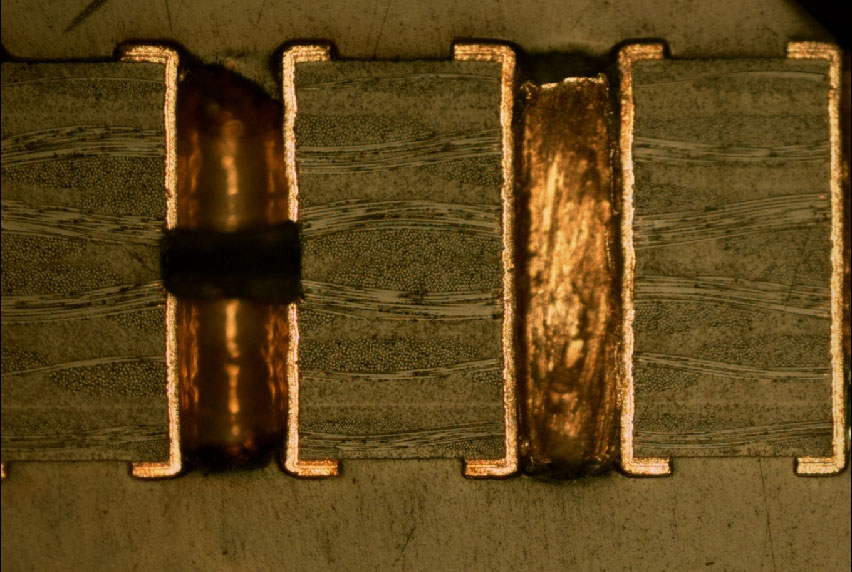
PCB via breaks typically manifest as a scattered pattern rather than a continuous break around the entire circumference; this is sometimes referred to as a “wedge-shaped via break.”
This type of problem frequently occurs in PCB manufacturing, and it can lead to an increase in the defect rate of the circuit boards.
Next, we will discuss the three common causes of hole-breaking and three effective solutions to this problem.
Reason 1: Improper processing of the de-gumming residue
One of the common causes of pore breakage is improper processing during the slag removal stage.
In PCB manufacturing, the process of removing adhesive residue typically involves the use of a foaming agent and etching with potassium permanganate.
The purpose of this process is to remove resin residue and create a microporous structure in preparation for subsequent processes.
Reason 2: Residual Oxidizing Agent
However, problems typically arise when the reducing acid solution is not adequately monitored. Residual oxidizing agents may remain on the pore walls.
When the circuit board enters the chemical copper plating process and undergoes micro-etching, the residual oxidizing agent is once again eroded by the acid, causing the resin in the areas where the residual oxidizing agent remains to peel off.
Reason 3: Improper use of hole-opening agents
Under these circumstances, the damaged pore walls will not react during subsequent treatment with palladium colloid and chemical copper plating; therefore, these areas will show no copper deposition.
Without a proper foundation, the copper plating naturally cannot provide complete coverage, resulting in spot-like holes.
Solution
To resolve the issue of spotty holes, the following measures can be taken:
1. Closely monitor the process for removing slag
Ensure that the slag removal process is properly monitored and controlled, including the use of expanding agents and the permanganate leaching operation. This will help reduce the occurrence of slag-related issues.
2. Improve Monitoring of Reducing Acid Solutions
Strengthen monitoring of the reducing acid solution to ensure that no oxidizing agent remains on the borehole walls. This can be achieved through regular inspections and testing.
3. Improve the quality of whole-hole treatment
Ensure that the whole-hole treatment is performed properly to prevent damage to the borehole walls. This may require adjusting the treatment parameters and process procedures.
In PCB manufacturing, every step must be strictly controlled, because chemical reactions can sometimes occur gradually in overlooked areas, thereby damaging the entire circuit.
Although dot-shaped hole failure is common, its occurrence can be effectively reduced through proper monitoring and control.
If you are manufacturing PCBs, be sure to pay close attention to the adhesive residue removal process, the monitoring of reducing acid solutions, and the handling of hole-cleaning agents, as these steps will help improve product quality and reduce the defect rate.
Frequently Asked Questions
1. What problems can a hole in the membrane cause?
Holes in the circuit board can lead to an increase in the defect rate because they compromise the integrity of the electrical connections.
2. Why is the de-slagging process important?
The quality of the resin residue removal process directly affects the smooth progress of subsequent processes; it helps remove the resin residue and prepare the pore wall surfaces.
3. How do you monitor the regenerating acid solution?
Monitoring the regeneration of the acid solution can be achieved through regular inspections and tests to ensure that no oxidizing agent remains on the pore walls.
4. Can the de-slagging process completely prevent pore rupture?
Although the process of removing slag can reduce the incidence of pore rupture, it cannot completely eliminate this problem. Therefore, a combination of measures is needed to mitigate the risk.
5. How does a cracked condition affect the reliability of a circuit board?
Holes in the circuit may result in incomplete electrical connections, thereby affecting the reliability and performance of the circuit board. Therefore, it is crucial to identify and resolve this issue as early as possible.
