

When manufacturing high-quality PCBs, different surface treatment processes have varying effects on the performance and reliability of the PCBs.
Jingpeng Electronics will introduce several common surface treatment processes, including oxidation resistance, tin plating, lead-free tin plating, electroless gold plating, electroless tin plating, electroless silver plating, hard gold plating, full-board gold plating, gold fingers, nickel-palladium-gold, and OSP, and will discuss their characteristics and selection criteria for different applications.
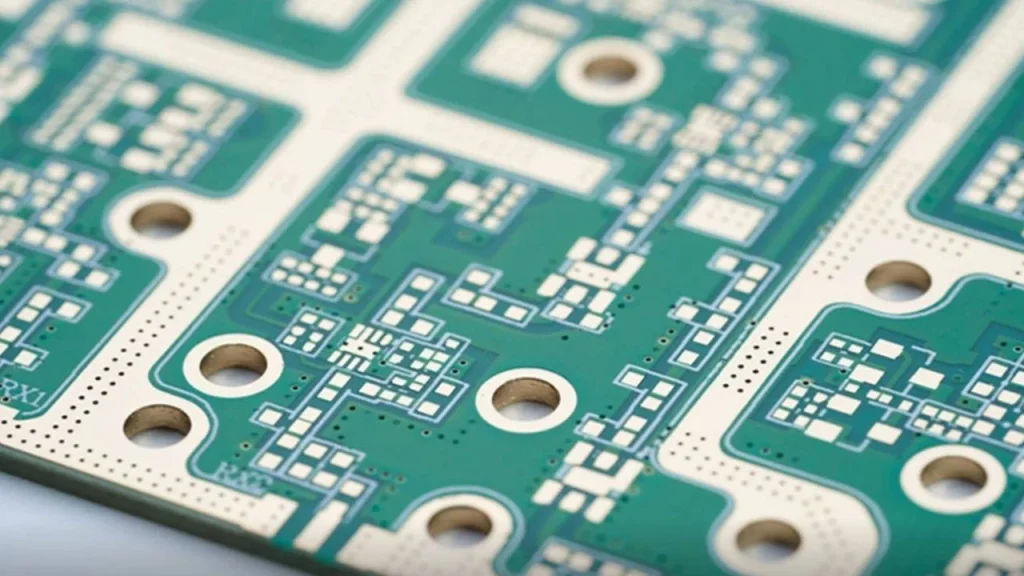
Antioxidant Treatment
Antioxidation treatment is a process that protects the surface of a PCB from oxidation. It typically involves applying a layer of gold or tin to the surface of the PCB to prevent oxygen and moisture from corroding it.
This process is relatively low-cost and offers good weldability, but it requires strict storage conditions and has a short shelf life, making it unsuitable for long-term storage. The oxidation-resistant treatment is an environmentally friendly process that produces good weld results and a smooth surface.
Tin-spraying Process
Tin spraying is commonly used for multilayer, high-precision PCB prototypes, particularly those with 4 to 46 layers. This process involves spraying tin onto the PCB surface to form a uniform layer of tin. Tin-sprayed PCBs are widely used in fields such as telecommunications, computing, medical equipment, and aerospace.
One such application is the gold finger, a component on a memory module that connects it to the memory slot and is used to transmit signals. Gold fingers consist of conductive contacts that are typically gold-plated to ensure good electrical conductivity. However, due to the high cost of gold, some devices—particularly price-sensitive ones—have begun using tin plating as an alternative to gold plating.
Gold Plating
Gold plating is a common surface treatment process, particularly suitable for high-density PCBs. It addresses some of the issues associated with tin plating, such as pad flatness and short shelf life.
In surface-mount technology, particularly for ultra-small components such as 0603 and 0402, the flatness of the pads directly affects the quality of the solder paste printing process; therefore, full-board gold plating is very common in high-density and ultra-small surface-mount applications. Furthermore, gold-plated boards have a significantly longer shelf life than tin-plated boards, making them the preferred choice during the prototyping phase.
Gold Plating
Electrolytic gold plating is a high-quality surface treatment process that offers several advantages. First, unlike gold plating, electrolytic gold plating forms a different crystal structure and has a golden yellow color, which customers find more appealing. Second, electrolytic gold plating is easier to solder than gold plating; it does not cause soldering issues and is less prone to soldering defects.
In addition, since only the pads on a gold-plated board are coated with nickel-gold, the skin effect has a minimal impact on signal quality. Gold plating has a denser crystal structure than gold electroplating, making it less prone to oxidation, and it bonds more securely to the solder mask on the circuit traces and the copper layer.
Electrolytically Plated Gold Board vs. Gold-Plated Board
Although electroplating remains an effective surface treatment method, electroless gold plating offers distinct advantages in certain respects. It is better suited for high-density PCBs, particularly those using ultra-small surface-mount technology. The golden color of electroless gold-plated boards is more popular, and they provide better soldering results and are less prone to soldering issues.
In addition, because of their different crystal structures, immersion-gold boards are less affected by the skin effect and are therefore suitable for high-frequency signal transmission. Although immersion-gold boards are slightly more expensive than gold-plated boards, they are a better choice for products that require high performance and reliability.
When selecting a PCB surface treatment process, several factors must be considered, including cost, application, performance, and reliability. Different processes are suitable for different situations.
Antioxidant treatment is suitable for some simple applications, while tin plating is suitable for high-precision PCBs. Gold plating remains a viable option in many cases, but electroless gold plating offers distinct advantages in certain respects and is particularly well-suited for high-density and high-performance applications.
Therefore, when manufacturing PCBs, selecting the most appropriate surface treatment process is crucial to ensuring the product's performance and reliability.
Frequently Asked Questions
1. Why choose immersion-gold-plated boards instead of electroplated gold-plated boards?
Immersion gold boards offer significant advantages in high-density PCBs and ultra-small surface-mount processes. Their golden color is more popular, they provide better soldering results, and they are less prone to soldering issues. In addition, due to their distinct crystal structure, immersion gold boards are less affected by the skin effect, making them suitable for high-frequency signal transmission.
2. Is the antioxidant treatment environmentally friendly?
Yes, the anti-oxidation treatment is an environmentally friendly process that protects the surface of PCBs from oxidation and extends their service life.
3. What is the shelf life of electroplated gold boards?
Immersion-gold boards typically have a longer shelf life than electroplated gold boards and can be stored for several months or even longer.
4. What applications are tin-plated sheets suitable for?
Tin-plated copper clad laminates are typically used for multilayer, high-precision PCB prototypes, particularly those with 4 to 46 layers. They are widely used in fields such as telecommunications, computing, medical equipment, and aerospace, including for connectors such as gold fingers.
5. What is the difference between gold-plated and silver-plated boards?
Electroplated gold and electroplated silver are both high-quality surface treatment processes, but they use different metals. Electroplated gold uses metallic gold, while electroplated silver uses metallic silver. The two differ slightly in terms of performance and applications, and the specific choice depends on the requirements.
We hope this FAQ helps you better understand the various surface treatment processes and their applications. If you have any other questions or need further information, please feel free to contact our team of experts.
