

In this article, we will take an in-depth look at the manufacturing process of multilayer PCBs, with a particular focus on the lamination process and related key concepts.
What is the lamination process?
It typically involves layering copper foil, prepreg, and the core board (inner layers) with pre-printed circuits in a specific order, then passing them through a press to undergo hot pressing under high temperature and pressure, fusing them into a single unit, followed by cold pressing to release stress and ensure the final product is flat. In this process, hot pressing is critical, while cold pressing serves a supporting role.
The Key Role of Hot Pressing
Under high-temperature and high-pressure conditions, the resin in the prepreg melts and flows, filling the patterns on the core sheet; the resin then gels, firmly bonding the layers together. The key to this process lies in the phase transition of the resin, which undergoes an irreversible change from “Stage A → Stage B → Stage C” at high temperatures.
Typically, only high-layer-count PCBs (≥3 layers) undergo the lamination process. The core concept of the lamination method is to gradually increase the number of layers through multiple lamination steps, thereby producing high-precision PCBs, such as HDI (High Density Interconnect).
Key Factors Affecting the Laminating Result
1. PP sheets (semi-cured sheets, bonding sheets)
PP sheets are a type of material made from resin that has not fully cured; therefore, they are also known as prepregs or bonding sheets. This partially cured resin (Stage B resin) exhibits flow properties under high-temperature and high-pressure conditions, enabling it to rapidly fill and bond the layers together to form an insulating layer. The quality of PP sheets significantly affects the reliability and stability of multilayer PCBs. To ensure the production quality and reliability of high-density multilayer PCBs during the lamination process, selecting high-quality PP sheets is crucial.
2. Press
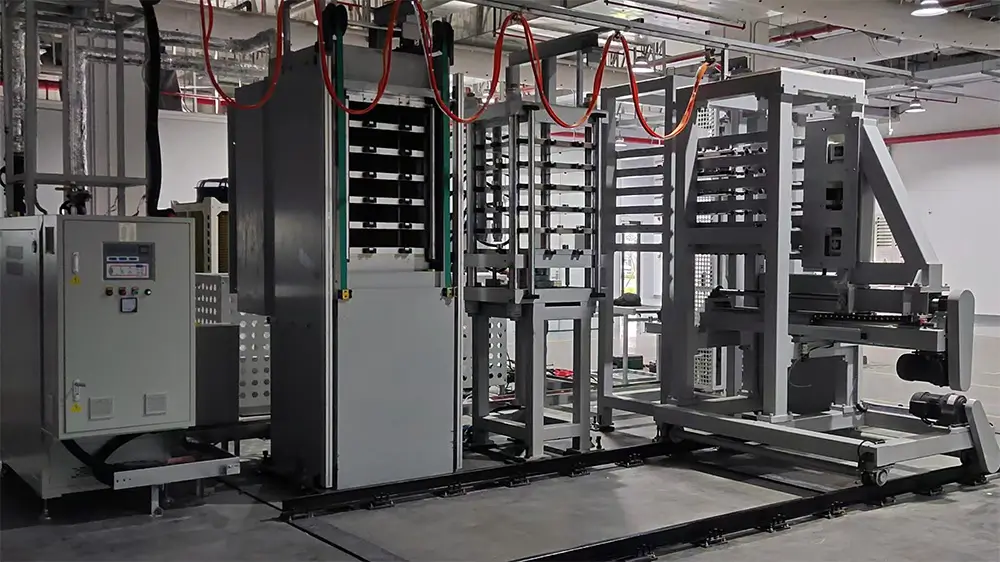
The quality of the press often determines whether high-quality, high-layer-count PCBs can be produced. However, high-quality presses are often quite expensive, so some manufacturers may choose to outsource the lamination process to other companies. Nevertheless, this outsourcing approach increases production costs, lengthens lead times, and leads to greater instability in product quality. Professional PCB manufacturers typically invest in high-quality press equipment to ensure product quality and on-time delivery. For example, Shenzhen Huashengxin PCB Manufacturing uses imported Japanese press equipment to ensure the high-quality production of high-layer-count PCBs.
These machines are equipped with precise hot-press and cold-press control systems that accurately regulate the heating and cooling cycles of the hot plates, as well as changes in hydraulic pressure and temperature. They feature specially calibrated controllers to ensure processing accuracy and quality in the manufacture of high-layer-count PCBs, while maintaining a low failure rate.
3. Auxiliary Materials
Although auxiliary materials are often overlooked when discussing the lamination process, they actually have a significant impact on the lamination results. The proper selection and use of auxiliary materials can significantly improve lamination results, thereby enhancing the quality and performance of high-layer-count PCBs.
In the manufacturing of high-layer-count PCBs, selecting the right auxiliary materials is crucial to the product’s performance and stability. Shenzhen Huashengxin PCB Manufacturer is committed to providing high-quality high-layer-count PCBs by selecting high-quality copper-clad laminates and matching PP sheets to ensure the high reliability and stability of these PCBs.
The 4 Key Process Steps in the Laminating Process
- Browning: Through chemical treatment, an oxide layer is formed on the inner copper surface to increase adhesion.
- Laminated Plate Riveting: Align and stack the PP sheet and the inner layer board, then secure them together using a riveting machine or a hot-melt machine.
- Lamination: Components such as auxiliary materials, copper foil, PP sheets, and pre-stacked core boards are fed into the press via an automatic reflow line, where the layers are bonded together into a single unit. It should be noted that the use of copper foil and PP sheets is not mandatory; the specific requirements may vary depending on manufacturing needs.
- Post-pressing treatment: The laminated boards are processed to prepare them for further production. Among these steps, X-ray layer inspection and milling the target holes are among the most important processes.
Detailed Process for Laminating Multilayer Printed Circuit Boards
The process of manufacturing PCBs can be summarized as follows:
1. Browning
Browning is the first step in PCB manufacturing. It involves exposing the base material to an oxidizing environment to form a protective oxide layer. This helps improve the circuit board's corrosion resistance.
2. Cut the PP
In this step, the prepreg is cut to the appropriate size for subsequent use. Prepreg is a key material in the manufacture of multilayer PCBs and consists of resin and reinforcing materials.
3. Pre-stacking
During the pre-layup stage, the cut prepreg is layered onto the core board to prepare for the subsequent multilayer fabrication process. The core board is a rigid panel coated with copper foil on both sides and serves as one of the base materials for PCBs.
4. Overlapping
Lamination is a key step in the manufacture of multilayer PCBs. In this process, pre-stacked prepreg and core boards are layered together in a specific sequence to form a multilayer structure. These layers will form the circuit connections in subsequent steps.
5. Riveting or Welding
In this step, the layers of a multilayer PCB are securely bonded together. This can be achieved through riveting or fusion bonding, depending on the manufacturing process and requirements.
6. Clamping Plate
Pressing is a critical process for ensuring a tight bond between the layers of a multilayer PCB. By applying high temperature and high pressure, it ensures that all layers are fully cured and tightly bonded.
7. Disassemble the board
After the lamination process is complete, remove the PCB from the lamination machine. This is a critical step, so handle it with care to prevent damage.
8. Drilling target holes for X-rays
X-ray hole inspection is performed to ensure the quality of multilayer PCBs. X-ray technology is used to verify that the holes within the board are properly aligned.
9. Gong Edge
Edge finishing is the process of treating the edges of a PCB to ensure they are flat and precise.
10. Beveling/Rounding Corners
Finally, the edges of the PCB are sanded or rounded to make them smoother and ensure they meet design requirements.
Challenges in the Laminating Process
The manufacture of multilayer PCBs typically involves a lamination process, which is a complex procedure.
Each pressing operation must be performed at high temperatures to ensure the material cures, which increases production time and costs.
In particular, when manufacturing high-layer-count PCBs, the increased number of lamination cycles leads to longer production cycles and lower production efficiency, which poses a challenge in the competitive market.
In addition, for many small and medium-sized enterprises, the machinery and technical requirements for manufacturing complex, multi-layer PCBs pose a significant challenge. This requires a high level of technical expertise and investment in equipment.
The lamination process is critical to the manufacture of multilayer PCBs, ensuring that the layers are tightly bonded together, which affects the product's performance and quality.
Frequently Asked Questions (FAQs)
1. What is a PCB?
A PCB, short for Printed Circuit Board, is a platform used to support, connect, and transmit electrical signals between electronic components. It plays a vital role in electronic products, enabling compact and intuitive circuit designs.
2. How complex is the manufacturing process for PCBs?
The manufacturing process for PCBs is relatively complex and involves several steps, including browning, cutting, pre-stacking, lamination, riveting or fusing, pressing, de-stacking, X-ray inspection, edge routing, and edge grinding/rounding.
3. Why is the lamination process for PCBs so important?
The lamination process for PCBs ensures a strong bond between the layers, which directly affects the performance and reliability of the circuit board. Improper lamination can lead to quality issues with the circuit board.
4. Why does the production cycle for multilayer PCBs take so long?
Manufacturing multilayer PCBs requires multiple lamination cycles, each of which takes a considerable amount of time, not to mention the additional time required for heating and cooling. This results in a longer production cycle and higher production costs.
5. How can we address the challenges involved in PCB manufacturing?
Addressing the challenges in PCB manufacturing requires technological upgrades and investment in equipment. At the same time, a continuous focus on improving manufacturing processes and increasing efficiency is also key to overcoming these challenges.
