The automotive industry has consistently pursued innovation with the goal of enhancing the automation capabilities of automotive applications, thereby providing users with a smarter, more efficient, and more convenient mobility experience. This objective encompasses multiple aspects, ranging from environmental improvements and enhanced safety to increased convenience and user-friendliness. In this article, we will delve deeply into these three key areas, highlighting the automotive industry’s efforts and achievements in realizing smarter mobility.
Environmental Improvements: Moving Toward Green Transportation
In modern society, there is growing concern about environmental issues, and the automotive industry is actively seeking solutions to reduce its environmental impact. From improving fuel efficiency to reducing exhaust emissions, and from traditional gasoline and natural gas vehicles to hybrid and fully electric models, automakers are constantly innovating to drive the industry toward a greener and more sustainable future. As a symbol of eco-friendly transportation, electric vehicles have become a strategic priority for the automotive industry, opening up new possibilities for future mobility.
Improving Safety: Moving Toward an Era of Zero Accidents
Traffic accidents have always been a major concern, and to improve driving safety, the automotive industry is committed to introducing more advanced safety technologies. From basic airbags to the application of technologies such as radar monitoring, 3D cameras, infrared surveillance, and automatic evasion systems, all are designed to reduce the occurrence of traffic accidents and ensure the safety of drivers and passengers. Among these, autonomous driving technology—as one of the most promising fields today—is attracting significant attention and investment, heralding the possibility of a future with zero accidents.
Convenience and User-Friendliness: A Smart Travel Experience
In its pursuit of smarter mobility, the automotive industry is also focused on providing a more convenient and user-friendly travel experience. This encompasses a wide range of areas, including audio, video displays, climate control, computing, communications, the Internet, navigation, and electronic toll collection systems. By integrating high-tech features, driving becomes more comfortable and convenient, thereby meeting users’ diverse mobility needs.
Automotive PCBs: The Key to Smart Cars
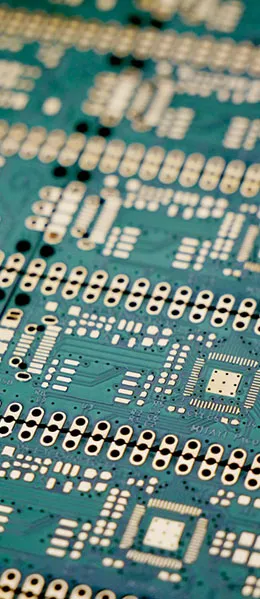
In the process of achieving the above goals, printed circuit boards (PCBs) play a critical role in automotive electronic systems. Automotive PCBs must not only meet the environmental, safety, and convenience requirements mentioned above, but also satisfy the following basic requirements:
Quality Assurance Requirements
To ensure the quality and reliability of automotive PCBs, manufacturers and distributors must adhere to a rigorous quality management system. The automotive industry, in particular, demands a high level of reliability and stability. As a global technical standard for the automotive industry, ISO/TS 16949 integrates the sector’s specific requirements, emphasizing defect prevention, quality consistency, and waste reduction, and establishes rigorous standards to ensure the quality and performance of automotive PCBs.
Performance Requirements
As the automotive industry strives for smarter and more efficient applications, automotive PCBs must meet requirements for high reliability and lightweight design:
High Reliability
The reliability of automotive PCBs is primarily reflected in two aspects: the service life of electronic components and environmental adaptability. Since the average service life of a vehicle is 10 to 12 years, automotive PCBs must have a correspondingly long service life. At the same time, automotive PCBs must be able to withstand harsh climatic and environmental conditions—such as extreme temperatures, humidity, rain, vibration, and electromagnetic interference—to ensure they maintain excellent performance under all conditions.
Lightweight and Compact Design
Weight reduction and miniaturization are aimed at saving fuel and improving a vehicle’s energy efficiency. By increasing PCB density, reducing surface area, making them thinner, and incorporating multiple layers, automotive PCBs can be made lighter and smaller without compromising performance, thereby contributing to improved vehicle performance.
The Diversity of Automotive PCBs
Modern automotive technology combines traditional and cutting-edge scientific and technological advancements, resulting in a wide variety of automotive PCBs. Based on different functional requirements, automotive PCBs can be classified into two types: those based on inorganic ceramics and those based on organic resins. Ceramic-based PCBs offer high heat resistance and dimensional stability, making them suitable for engine systems operating in high-temperature environments. Resin-based PCBs, on the other hand, are better suited for most modern vehicles due to their superior manufacturability and lower cost.
Automotive PCBs play a crucial role in enabling smarter, more efficient automotive applications. Not only do they serve as the foundation for various smart technologies, but they also support sustainable development in the automotive industry.
Frequently Asked Questions
Q1: What is ISO/TS 16949 certification?
A: ISO/TS 16949 certification is a technical standard for the global automotive industry designed to ensure the effectiveness of quality management systems in the automotive sector, with an emphasis on defect prevention, consistent quality, and waste reduction.
Q2: Why are weight reduction and miniaturization important for automobiles?
A: Weight reduction and downsizing help save fuel and improve a vehicle's energy efficiency, thereby lowering operating costs and reducing environmental impact.
Q3: Why Do Automotive PCBs Need to Be Highly Reliable?
A: The high reliability of automotive PCBs ensures that electronic components function properly over the long term while withstanding the effects of various harsh environmental conditions.
Q4: What is the difference between organic resin-based PCBs and ceramic-based PCBs?
A: Organic resin-based PCBs are easier to manufacture and are suitable for most modern vehicles, while ceramic-based PCBs offer high heat resistance and are suitable for engine systems operating in high-temperature environments.
Q5: What are the future trends in automotive PCBs?
A: In the future, automotive PCBs will place greater emphasis on diversity, high reliability, and lightweight design to meet the demands of smart, eco-friendly mobility.
On the path toward smarter mobility, the automotive industry is constantly striving to innovate, driving the automation capabilities of automotive applications to new heights. From environmental improvements to enhanced safety, and from greater convenience to more user-friendly features, automakers are actively exploring various technologies and solutions to create a better travel experience for users. At the same time, automotive PCBs, as key components, are quietly supporting the rise of smart cars behind the scenes.