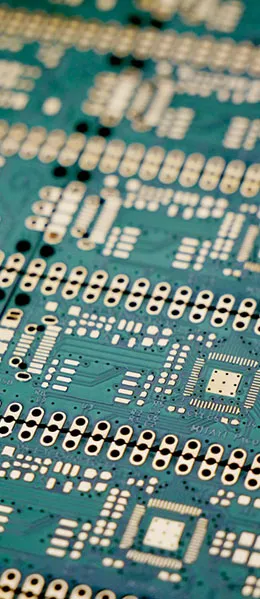
In the circuit board manufacturing process, single-sided and double-sided boards are two common types. There are many differences between them; from materials to manufacturing processes to applications, each has its own merits.

Differences in Materials
Single-sided board
A single-sided board, as the name implies, has copper foil on only one side.
This type of circuit board is suitable for relatively simple electronic devices, such as the circuit boards commonly found in televisions.
Single-sided boards are relatively inexpensive to manufacture, but they have some limitations when it comes to circuit routing and component placement.
Double-sided board
Unlike single-sided boards, double-sided boards have copper traces on both sides. The copper traces on these two sides are connected by conductive through-holes.
This type of circuit board is typically used in more complex electronic devices because it offers more routing options.
However, because double-sided boards require the processing of multiple layers of copper foil during manufacturing, their production costs are typically much higher than those of single-sided boards.
Pseudo-double-sided board
In addition to single-sided and double-sided boards, there is another type known as a pseudo-double-sided board.
Pseudo-double-sided boards typically do not have through-hole connections, which reduces their manufacturing costs.
Components are inserted on one side, and soldering is performed on the other. This type of circuit board is typically used in cost-sensitive applications.
Differences in Manufacturing Processes

Single-sided board
On a single-sided PCB, solder joints are primarily concentrated on one side. Generally, the other side is mainly used for through-hole components, but some products may also have SMD (surface-mount) components on the copper trace side.
Double-sided board
Double-sided boards offer greater flexibility because components can be soldered on both sides. This means that both through-hole and SMD components can be used, depending on the design requirements.
Pseudo-double-sided board
In pseudo-double-sided boards, components are typically inserted on only one side, while soldering is performed on the other side. The copper foil traces are connected by soldering on both sides of the component leads.
Applications of PCBs
Single-sided board
In a single-sided board, the metal traces are laid out on an insulated substrate, which also serves to support the components. This type of circuit board is suitable for simple applications with relatively few component connections.
Double-sided board
Double-sided boards come in handy when more circuit connections are needed. They allow circuits to be laid out on both sides and use through-holes to connect the two sides.
Production Process Flow
Single-sided board
The manufacturing process for single-sided printed circuit boards is relatively simple. It includes the following steps: cutting, drilling, outer layer patterning, etching, inspection, screen printing of solder mask, tin plating, screen printing of characters, contour machining, testing, and final inspection.
Double-sided board
The manufacturing process for double-sided boards is more complex. Taking the tin-spraying process as an example, it involves multiple steps, including cutting, drilling, electroless copper plating/copper thickening, dry film application, pattern plating, etching, wet film application, gold plating of connectors, tin spraying, character marking, electrical testing of the board outline, final inspection, final approval, and packaging.
When selecting a circuit board type, it is important to consider the product’s complexity, manufacturing costs, and performance requirements. Single-sided, double-sided, and pseudo-double-sided boards each have their own characteristics, and the most suitable type can be chosen based on the specific application.