

The PCB manufacturing process involves numerous steps—more than 100 in total—and requires not only a large number of machines but also expensive equipment. As such, PCB manufacturers—being a capital-intensive manufacturing sector—typically maintain stable working capital and demonstrate strong financial standing, making them reliable suppliers worth considering.
In this article, we will provide a detailed overview of the various pieces of equipment required for the PCB manufacturing process, including the production of both simple single-layer boards and multilayer boards.
Equipment for Manufacturing Single-Ply Panels
1. Engineering Production
- Light Painting Machine: A light pattern used to etch a PCB.
- Film Exposure Unit: Expose the designed circuit pattern onto a photosensitive material.
2. Cutting
- Cutting Machine: Used to cut raw sheets to the desired size.
- Oven: Used for drying and curing PCB panels.
3. Drilling
- CNC Drilling Machine: Used to drill holes in a PCB for component mounting.
4. Grinding Plate
- Grinding Machine: Smooth the surface of the PCB to prepare it for subsequent processes.
5. Plated-Through Holes (PTH)
- Chemical Copper Production Line: Used to coat the inside of the hole with copper to ensure an electrical connection.
6. Graphic Transfer
- Film Application Machine: Transfer the light pattern onto the surface of the PCB.
- UV exposure system or LDI: Used to expose PCBs and cure the photosensitive material.
7. Patterned Plating
- Electroplating Production Line: Copper is deposited onto a PCB using an electrochemical process to form circuit paths.
8. Remove the dry (or wet) film
- Film-Stripping Production Line: Remove the unwanted photosensitive material.
9. Graphic Etching
- Etching Production Line: Etch away the excess copper to form the circuit pattern.
10. Solder Mask Application
- Screen Printing Machine: Printing the solder mask on the PCB.
- UV exposure system or LDI: Expose to cure the solder mask.
11. Baking and Curing
- Oven: A material used to cure each layer.
12. Surface Treatment
- OSP Production Line 或 Chemically Plated Nickel-Gold Wire 或 Electrolytically Deposited Nickel-Palladium-Gold Wire: Used for surface treatment to improve the corrosion resistance of PCBs.
13. Molding
- Press or CNC milling machine: Cut the PCB into the desired shape.
- Cutting Machine: Cut the PCB further.
14. Testing
- Electrical Tester: Check the continuity of the circuit.
- AOI: Automated optical inspection to check appearance and weld quality.
- 3DAOI: 3D automated optical inspection for more precise assessment of weld quality.
Equipment for Manufacturing Multilayer Boards
1. Laminating
- Browning Production Line: Used for processing inner-layer circuit boards.
- Laminating Machine: Laminate multiple inner PCB layers together.
- Grinding Machine: Smooth the surface of the multilayer board.
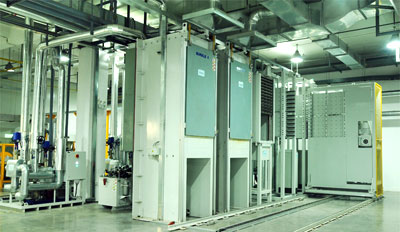
2. Reliability Testing
- Solder Pot: Used for welding.
- Fluorescent Thickness Gauge: Measure the thickness of the electroplated layer.
- Microscope: Check the installation and connections of the components.
- Environmental Test Machine: Simulate performance under various environmental conditions.
- Slice Grinder: Prepare samples for microscopic examination.
- Sampler: Collect samples for testing.
- Reflow Oven: For re-welding.
- High-Resistance Meter: Measure the resistance of the circuit.
- Dust Particle Counter: Detect污染 particles.
- X-RAY: Used to inspect solder joints and internal connections.
3. Wastewater Treatment
- This step is very important and requires a dedicated wastewater treatment system to treat the wastewater.
These devices play a critical role in the PCB manufacturing process, ensuring the quality and reliability of the final product. Whether manufacturing single-layer or multilayer boards, each step requires precise equipment to meet various requirements and standards.
Frequently Asked Questions
1. What is a PCB?
PCB stands for printed circuit board, which is a key component in electronic devices used to connect and support electronic components.
2. Why does PCB manufacturing require so much equipment?
PCB manufacturing involves several complex steps, each of which requires specific equipment to ensure the quality and reliability of the circuit.
3. What is AOI?
AOI stands for Automated Optical Inspection, a technology used to inspect the appearance and solder joint quality of PCBs.
4. How complex is the PCB manufacturing process?
The PCB manufacturing process is highly complex, encompassing multiple steps from design to production, including more than 100 major and minor processes, each of which requires precise equipment and technical support.
