

White Spots: Problems and Solutions
During the manufacturing of automotive printed circuit boards (PCBs) at PCB factories, the issue of white spots sometimes arises. This phenomenon typically occurs during the soldering process or the post-soldering cleaning process, and is primarily characterized by the appearance of white spots or white residue on the surface of the PCB, on the leads, or on or around the solder joints. The white spots may consist of reactants such as crystallized rosin, modified rosin, organic and inorganic metal salts, soldering compounds, flux, or cleaning agents, as well as other chemical substances generated by the high temperatures of the soldering process. Most white spot issues stem from chemical changes in the rosin or water-soluble acids present in the flux, resulting in substances that are less soluble in cleaning agents than their original components.
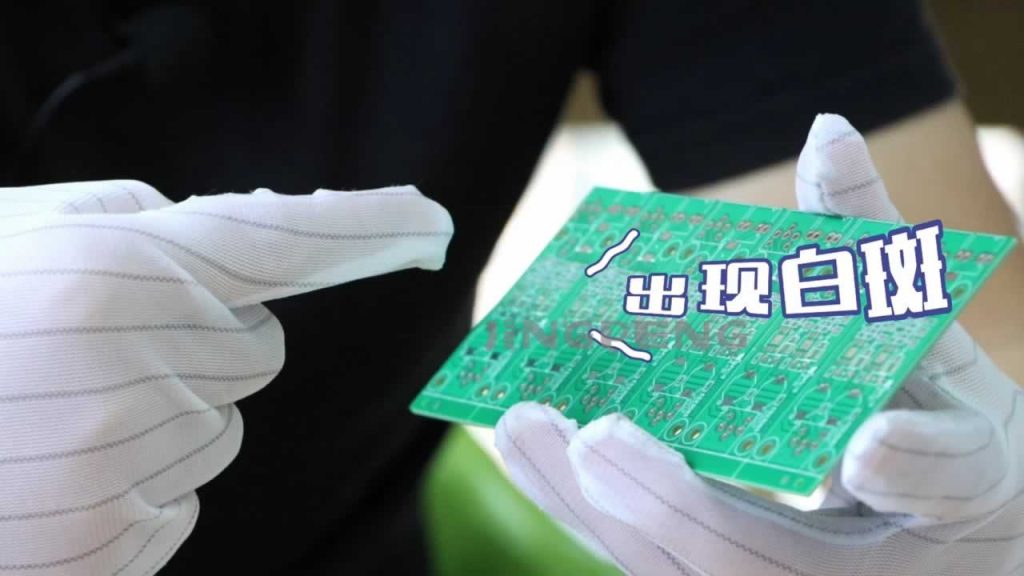
Solutions for Vitiligo
There are corresponding solutions for different types of white spots. For generally loose resin residues, a combination of different solvents can be selected based on the principle of “like dissolves like” and solubility coefficients to achieve swelling and dissolution, thereby cleaning and removing them. However, organic acids react with metals such as tin and lead, as well as their metal oxides, to form metal soaps. These hard metal salts cannot be removed by general solvents and require ultrasonic assistance for cleaning. Therefore, the formation of such residues can be minimized in the process by lowering the temperature and shortening the processing time.
In addition, the degradation of organic compounds after soldering poses challenges for formulating cleaning agents. Compounded by the variety of fluxes and chemical interference in the PCB manufacturing process, the presence of certain solvents in the flux compromises the original surface quality of the flux, leading to frequent occurrences of white spots. Resolving this issue requires the targeted selection of cleaning agents, taking multiple factors into comprehensive consideration.
The Impact of White Spot Issues on Automotive Circuit Board Manufacturing
There are various types of white spot issues, and they can have a certain impact on the quality of automotive circuit board products. This makes it crucial to identify the causes of these different types of white spots. White spot defects occur in both wave soldering and reflow soldering processes; their composition is highly complex, and their causes are difficult to predict. Therefore, in automotive PCB manufacturing, we must carefully analyze the root causes of white spot defects to identify solutions and ensure the quality and reliability of the final product.
Frequently Asked Questions (FAQs)
Q1: In which manufacturing processes are white spots likely to occur?
White spots are a common issue in wave soldering and reflow soldering processes.
Q2: Are the causes of vitiligo complex?
Yes, the causes of vitiligo are very complex and often involve the combined effects of multiple factors.
Q3: How do I choose the right cleaning agent to treat white spots?
Solving the problem of white spots requires selecting the appropriate cleaning agent and taking into account various factors, such as the type of solder flux and chemical interference in the PCB manufacturing process.
Q4: How do white spots affect product quality?
White spots can affect product quality and reliability, so it is necessary to identify the cause of the problem and take appropriate measures to resolve it.
Q5: What are some ways to treat vitiligo?
Different solutions can be applied depending on the type of white residue. Loose resin residue can be removed by selecting the appropriate combination of solvents, while hard metal salts require ultrasonic assistance for removal.
