

The performance and reliability of high-frequency circuits directly affect the operation of electronic devices. This article will introduce key techniques for designing and routing high-frequency PCBs to ensure high performance and low interference.
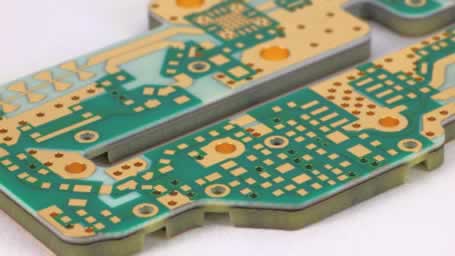
1. Use multilayer boards
High-frequency circuits typically require the integration of multiple functions and complex routing. To meet these requirements, multilayer boards are indispensable. Multilayer boards provide additional layers, allowing for more compact routing while also helping to reduce interference.
2. Minimize lead bending
Bends in the leads of high-frequency circuit components should be minimized. The best approach is to use completely straight leads. If a bend is necessary, use a 45° bend or a curved transition to reduce signal radiation and coupling.
3. Shorten the lead length
The length of leads in high-frequency circuits should be kept as short as possible, as this helps reduce signal propagation delay and loss.
4. Reduce layer alternation
The number of layer alternations is reduced to minimize the number of vias. Each via introduces distributed capacitance, so reducing the number of vias can improve circuit speed and performance.
5. Handling Parallel Traces
Parallel traces in high-frequency circuits can introduce crosstalk. If parallel traces cannot be avoided, a large ”ground” area can be placed on the opposite side of the parallel signal traces to reduce interference. Parallel traces on different layers should be arranged perpendicular to one another.
6. Ground Loop
For important signal lines or local components, you can use a ground enclosure. This involves drawing an outline around the selected object and connecting it to ”ground” to reduce interference.
7. Avoid Loops
Signal lines of all types should not form loops, and ground lines should not form current loops, to ensure circuit stability.
8. Add decoupling capacitors
High-frequency decoupling capacitors should be added near each integrated circuit block to filter out power supply noise.
9. Separating Analog and Digital Circuits
Analog and digital circuits should be laid out separately, and single-point connections should be used when connecting them to power and ground to avoid mutual interference.
10. Filter Capacitors and Shielding
For critical components such as the DSP, off-chip program memory, and data memory, filter capacitors should be added as close as possible to the chip’s power supply pins; shielding should also be considered to reduce external interference.
11. Clock Line Management
In systems with multiple memory devices, ensure that the distance from the clock line to the clock inputs of each memory device is equal, or use programmable clock driver chips. Clock line management is particularly important for DSP systems.
12. PCB Simulation
Finally, to ensure the performance of high-frequency circuits, you can use advanced PCB simulation software to perform simulations.
By following the key tips above, you can better design and route high-frequency PCB circuits, thereby improving system performance and reliability. Routing high-frequency circuits is a complex and critical task, but it is essential to the performance of electronic devices.
